Dashboard Warning Lights Meaning – Complete Guide for Car Owners


Modern cars in 2026 are no longer simple mechanical machines. They are now smart electronic systems on wheels that constantly monitor every small activity inside the vehicle. From engine performance to braking system, from battery health to tire pressure — everything is tracked in real time using advanced sensors.

​One of the most important communication systems inside every modern car is the dashboard warning light system. These small symbols on your dashboard are not just decorative lights — they are your car’s way of talking to you.

​In this comprehensive technical guide, we will decode the exact meaning of these essential dashboard warning symbols, understand the difference between amber and red alert levels, and learn what immediate actions you must take to prevent costly mechanical failures and ensure on-road safety.

One of the most important communication systems inside every modern car is the dashboard warning light system. These small symbols on your dashboard are not just decorative lights — they are your car’s way of talking to you.

Whenever something goes wrong inside the vehicle, the system immediately displays a warning light. These warnings can range from simple notifications like headlights ON to serious alerts like engine failure or brake system problems.

The biggest issue is that most drivers do not understand the meaning of these lights. Many people ignore them or continue driving without realizing the seriousness of the problem. This negligence often leads to expensive repairs, breakdowns, or even dangerous accidents on the road.

In this complete 2026 guide, we will understand dashboard warning lights in simple language so that every car owner can easily identify problems early and take the right action.


What Are Dashboard Warning Lights?

Dashboard warning lights are small indicators displayed on your vehicle’s instrument cluster. These lights are connected to various sensors installed in different parts of your car.

Whenever a sensor detects an abnormal condition, it sends a signal to the car’s computer system (ECU), which then turns on the relevant warning light.

These lights help drivers understand:

  • What is happening inside the car
  • Whether the issue is minor or serious
  • When immediate action is needed

In simple words, dashboard lights act like a health report system for your vehicle.


Why Dashboard Warning Lights Are So Important

Ignoring dashboard warning lights is one of the biggest mistakes car owners make.

These lights are important because they:

  • Prevent major engine damage
  • Improve road safety
  • Reduce repair costs
  • Detect hidden problems early
  • Improve fuel efficiency
  • Protect engine, brakes, and transmission

A small warning today can prevent a major breakdown tomorrow.

For example, a simple oil warning light ignored for a few minutes can damage the entire engine. That is why understanding these lights is extremely important.


Types of Dashboard Warning Lights

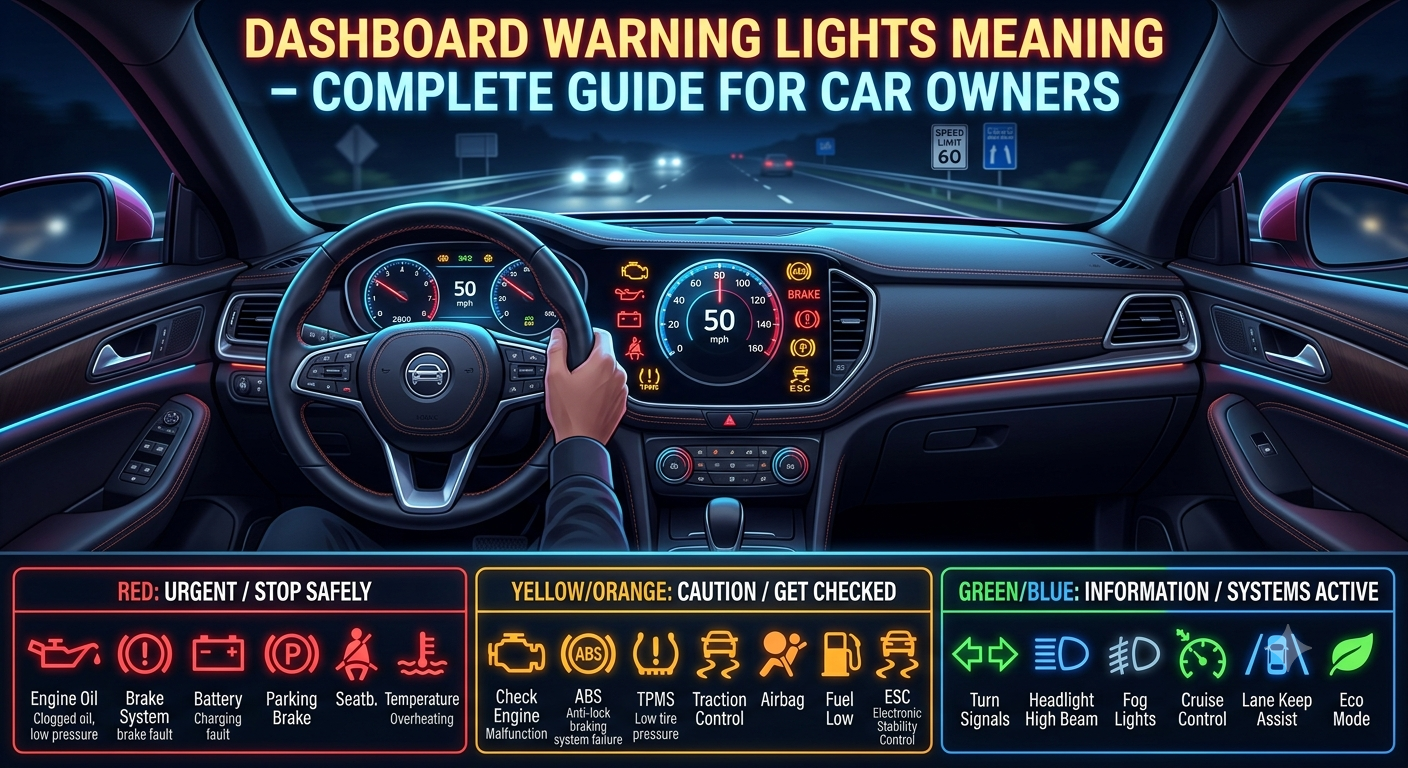
Dashboard warning lights are divided into three major categories based on severity.


🟢 Green or Blue Indicator Lights (Normal Status)

These lights are not warnings. They simply show that a system is active.

Examples:

  • Headlights ON
  • Turn signals
  • Cruise control active
  • High beam indicator

👉 These lights do not indicate any problem. They only inform the driver.


🟡 Yellow or Orange Warning Lights (Caution)

Yellow lights indicate that something is not normal, but the vehicle can still be driven carefully.

Examples:

  • Check engine light
  • Tire pressure warning
  • ABS warning
  • Traction control warning

👉 These issues should be checked soon, but not always emergency.


🔴 Red Warning Lights (Danger)

Red lights indicate serious problems that require immediate attention.

Examples:

  • Engine overheating
  • Oil pressure warning
  • Brake system failure
  • Battery charging failure

👉 Red lights should NEVER be ignored. Stop the vehicle safely if possible.


Check Engine Light Explained

The check engine light is one of the most common and confusing warning lights.

It appears as an engine-shaped symbol on the dashboard.

Possible Causes:

  • Loose fuel cap
  • Faulty oxygen sensor
  • Engine misfire
  • Fuel injection issues
  • Emission system failure

Important Behavior:

  • Solid light → moderate issue
  • Blinking light → serious engine damage risk

👉 If the light is blinking, stop the vehicle immediately.


Oil Pressure Warning Light

This is one of the most dangerous warning lights in any car.

It looks like an oil can symbol.

Causes:

  • Low engine oil level
  • Oil pump failure
  • Oil leakage
  • Clogged oil filter

Why It Is Serious:

Engine oil lubricates all moving parts. Without proper oil pressure, engine components start rubbing against each other and can get damaged within minutes.

👉 If this light appears, stop the engine immediately.


Battery Warning Light

This light indicates a problem in the charging system.

Causes:

  • Weak or dead battery
  • Alternator failure
  • Loose terminals
  • Broken belt

What Happens:

If ignored, the car may suddenly lose power and stop running because the battery will not recharge properly.


Engine Temperature Warning Light

This light indicates engine overheating.

Causes:

  • Low coolant level
  • Radiator problem
  • Water pump failure
  • Cooling fan malfunction

Risks:

Overheating can damage:

  • Engine head
  • Gasket
  • Pistons
  • Entire engine block

👉 Always stop and allow the engine to cool down.


Brake Warning Light

The brake warning light is directly related to your safety.

Causes:

  • Low brake fluid
  • Worn brake pads
  • Parking brake engaged
  • Brake system fault

👉 If brakes fail, accident risk becomes extremely high.


ABS Warning Light

ABS (Anti-lock Braking System) helps prevent wheel locking during emergency braking.

If ABS Light Turns ON:

  • ABS system is not working
  • Normal braking may still function
  • Emergency braking safety is reduced

Tire Pressure Warning Light

This light indicates incorrect tire pressure.

Effects of Low Pressure:

  • Poor fuel economy
  • Uneven tire wear
  • Weak control
  • Risk of tire burst

👉 Always maintain correct PSI recommended by manufacturer.


Traction Control Warning Light

This system helps maintain grip on slippery roads.

Causes:

  • Slippery surface (rain, snow)
  • Sensor issue
  • System malfunction

Sometimes it blinks normally when system is actively working.


Airbag Warning Light

This indicates a problem in the safety airbag system.

Causes:

  • Faulty sensors
  • Wiring issues
  • Airbag module failure

👉 If this light stays ON, airbags may not deploy in an accident.


What Should Drivers Do When Warning Lights Appear?

Instead of panic, follow a logical approach:

  • Identify the symbol
  • Check owner’s manual
  • Inspect basic fluids
  • Avoid long driving if red light appears
  • Use diagnostic scanner if possible
  • Visit mechanic for inspection

👉 Quick action can save thousands in repair costs.


Modern Smart Car Diagnostic Systems (2026)

Modern vehicles are highly intelligent.

They can:

  • Monitor engine health in real time
  • Store error codes
  • Send alerts to mobile apps
  • Track fuel efficiency
  • Detect emissions problems

This makes cars safer and easier to maintain than ever before.


Common Mistakes Car Owners Make

Many drivers damage their cars due to ignorance.

Common Mistakes:

  • Ignoring warning lights
  • Resetting lights without fixing problem
  • Skipping oil changes
  • Driving overheating engine
  • Delaying service

👉 These mistakes lead to expensive repairs.


Real-Life Importance of Warning Lights

Imagine driving on a highway and suddenly the oil pressure light turns ON. If ignored, the engine may seize completely within minutes.

Or if brake warning light is ignored, braking performance may fail during emergency stopping.

That is why these lights are not optional  information — they are life-saving alerts.Read also clutch-shoe-replacementdiy-mechanicsscooter-maintenance


Final Thoughts

Dashboard warning lights are one of the most important safety features in modern vehicles. They are designed to protect your engine, brakes, transmission, and overall driving safety.

Understanding these lights helps you:

  • Avoid breakdowns
  • Save repair costs
  • Improve safety
  • Extend vehicle life
  • Drive with confidence

Some warnings are minor, but some are extremely serious and require immediate attention.

A smart driver never ignores dashboard signals. Instead, they understand them and act on time.

In simple words, dashboard warning lights are your car’s voice — and listening to it can save both your money and your life.

Hello friends! If you liked this technical guide, please be sure to share it with your friends. If you have any questions, feel free to leave a comment or send me an email—I’ll be happy to provide full guidance. Thank you!

How to Fix Toyota Fortuner AC Cooling Issue: Complete DIY Repair Guide


One of the most common problems in a Toyota Fortuner AC system is weak cooling or warm air blowing from the vents…
If your Toyota Fortuner AC is not cooling properly, blowing warm air.

If your Toyota Fortuner AC is not cooling properly, blowing warm air, cooling only while driving, or taking too long to cool the cabin, there can be several possible causes

The problem may be as simple as a dirty cabin air filter or condenser, but it can also be related to refrigerant leakage, a cooling-fan problem, compressor failure, an expansion-valve issue, or an electrical fault..

Important: Toyota Fortuner AC systems can vary depending on the model year, engine, market, and equipment. Always use the correct service information and refrigerant specification for your particular vehicle.


Understanding the Toyota Fortuner Air Conditioning System

Before troubleshooting an AC cooling problem, it is important to understand how the system works.

The automotive air-conditioning system transfers heat from inside the cabin to the outside environment.

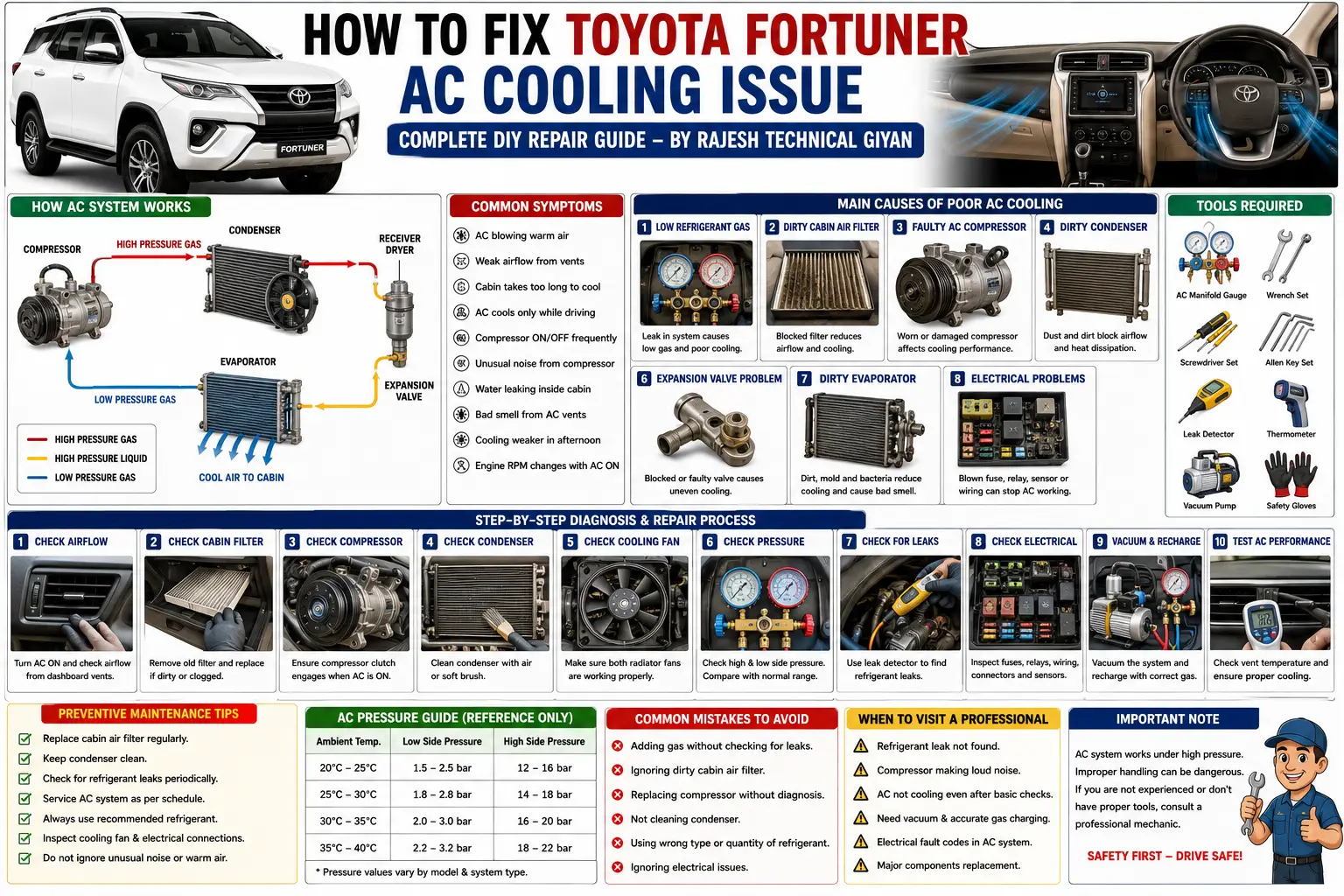
Major components may include:

  • AC compressor
  • Condenser
  • Receiver-drier or related refrigerant-storage component
  • Expansion valve
  • Evaporator
  • Refrigerant
  • Cooling fans
  • Cabin air filter
  • Pressure sensors
  • Temperature sensors
  • Blower motor
  • AC control system

When the AC is switched on, the compressor circulates refrigerant through the system.

The refrigerant releases heat through the condenser and then passes through the expansion device before entering the evaporator.

The evaporator absorbs heat from the cabin air, while the blower motor pushes the cooled air through the dashboard vents.

If any major component fails or refrigerant flow is interrupted, Toyota Fortuner AC cooling performance can decrease significantly.


Common Symptoms of Toyota Fortuner AC Cooling Problems

Correctly identifying the symptoms is the first step toward finding the actual fault.

Common symptoms include:

  • AC blowing warm air
  • Weak cooling from dashboard vents
  • Weak airflow
  • Cabin taking too long to cool
  • AC cooling properly while driving but poorly at idle
  • Compressor repeatedly switching on and off
  • Unusual compressor noise
  • Clicking or grinding sounds
  • Water or moisture inside the cabin
  • Bad smell from AC vents
  • Cooling becoming weak during hot afternoon driving
  • AC compressor failing to engage
  • AC working intermittently

Each symptom can point toward a different problem.


Why Is My Toyota Fortuner AC Not Cooling Properly?

There are several possible causes of poor AC cooling.

Let’s examine the most common ones.


1. Low Refrigerant or Refrigerant Leakage

One of the most common reasons for an AC cooling issue is insufficient refrigerant.

An automotive AC system is designed as a sealed system. Refrigerant should not normally disappear simply because of vehicle age.

If the refrigerant level is low, there may be a leak somewhere in the system.

Possible leak locations include:

  • Compressor seals
  • Condenser
  • Refrigerant hoses
  • Pipe connections
  • O-rings
  • Service ports
  • Evaporator
  • Other refrigerant-system joints

Symptoms of Low Refrigerant

You may notice:

  • Weak cooling
  • AC taking a long time to cool the cabin
  • Compressor cycling frequently
  • Cooling becoming weaker at higher temperatures
  • Poor cooling at idle

Important

Do not simply add refrigerant without checking the system.

A low refrigerant level can indicate a leak that needs to be located and repaired.

Also, the correct refrigerant type and charge amount must be confirmed from the vehicle-specific service information.


2. Dirty Cabin Air Filter

A dirty or clogged cabin air filter can significantly reduce airflow through the AC system.

When the filter becomes heavily blocked, the blower motor may struggle to push enough air through the evaporator.

Symptoms

A clogged cabin filter can cause:

  • Weak airflow
  • Poor cooling
  • Dusty cabin
  • Bad smell
  • Increased blower noise
  • Reduced AC performance

Solution

Inspect the cabin air filter regularly and replace it when necessary.

This is one of the simplest and least expensive maintenance procedures you can perform.

If the filter is extremely dirty, replacing it may noticeably improve airflow.


3. Faulty AC Compressor

The AC compressor is one of the most important components in the system.

It circulates refrigerant through the AC circuit.

A compressor can develop problems because of:

  • Internal wear
  • Bearing damage
  • Clutch problems on applicable systems
  • Seal failure
  • Insufficient lubrication
  • Contamination
  • Electrical problems

Common Symptoms

— Rajesh

A failing compressor may cause:

  • Poor cooling
  • No cooling
  • Unusual mechanical noise
  • Compressor not engaging
  • Intermittent cooling
  • Abnormal vibration
  • Refrigerant or oil leakage

If a compressor has suffered internal mechanical damage, metal particles can contaminate other AC components.

Therefore, replacing a compressor without diagnosing the rest of the system may result in repeated failure.


4. Dirty or Blocked AC Condenser

The condenser is responsible for releasing heat from the refrigerant.

It is normally positioned toward the front of the vehicle, where it can be exposed to:

  • Dust
  • Mud
  • Insects
  • Leaves
  • Road debris

A dirty condenser cannot transfer heat efficiently.

Symptoms

A restricted condenser may cause:

  • Weak AC cooling
  • Poor cooling at idle
  • Higher refrigerant pressure
  • Compressor cycling
  • Cooling becoming worse in heavy traffic

Solution

Inspect the condenser fins carefully.

Clean the condenser using an appropriate method without bending or damaging the delicate fins.

Do not use excessive water pressure directly against the fins.


5. Cooling Fan Not Working Properly

The AC condenser requires adequate airflow to remove heat.

If the cooling fan does not operate correctly, AC performance can become particularly poor when the vehicle is stationary.

Common Causes

  • Blown fuse
  • Faulty relay
  • Damaged fan motor
  • Wiring problem
  • Electrical connector problem
  • Control-system fault

Common Symptoms

One of the most important symptoms is:

AC cools well while driving but becomes warm at idle.

This can happen because natural airflow increases when the vehicle is moving.

At idle, the cooling fan must provide sufficient airflow through the condenser.

Always check fan operation when diagnosing this type of AC problem.


6. Expansion Valve Problem

The expansion valve or equivalent refrigerant-flow control device regulates refrigerant entering the evaporator.

If the valve becomes restricted or malfunctions, refrigerant flow can become abnormal.

Possible Symptoms

  • Poor cooling
  • Uneven cooling
  • Abnormal AC pipe temperatures
  • Ice formation in some conditions
  • Compressor cycling
  • Reduced evaporator performance

A faulty expansion valve generally requires replacement after proper diagnosis.

Do not replace it simply because cooling is poor; other AC faults can produce similar symptoms.


7. Dirty Evaporator

The evaporator is located inside the HVAC housing and absorbs heat from cabin air.

Over time, dust, dirt, moisture, and biological contamination can accumulate on the evaporator surface.

Symptoms

  • Weak airflow
  • Bad smell
  • Reduced cooling
  • Excessive moisture
  • Dust coming from vents

A heavily contaminated evaporator may require professional cleaning.

Regular cabin-filter replacement can help reduce contamination entering the HVAC system.


8. Electrical and Sensor Problems

Modern Toyota vehicles use electrical controls and sensors to manage AC operation.

A fault in the electrical system can prevent the compressor or cooling fan from operating correctly.

Possible problems include:

  • Blown fuse
  • Faulty relay
  • Pressure-sensor problem
  • Temperature-sensor problem
  • Damaged wiring
  • Loose connector
  • Control-module fault

Diagnosis

A professional diagnostic process may include:

  1. Checking AC-related fuses.
  2. Checking relays where applicable.
  3. Inspecting electrical connectors.
  4. Checking wiring.
  5. Scanning for relevant diagnostic trouble codes.
  6. Checking sensor data where supported.
  7. Confirming compressor and fan operation.

Electrical diagnosis should be performed before replacing expensive components.


Step-by-Step Toyota Fortuner AC Troubleshooting

If your Fortuner AC is not cooling properly, follow a logical diagnostic sequence.

Step 1: Check the Cabin Airflow

Turn the AC on and check airflow from the vents.

If airflow is weak, inspect the:

  • Cabin filter
  • Blower motor
  • HVAC air passages
  • Evaporator

Step 2: Check AC Compressor Operation

Observe whether the compressor operates when AC cooling is requested.

Do not assume that a compressor not operating means the compressor itself is defective.

The cause could be electrical or related to system pressure.

Step 3: Inspect the Condenser

Check the condenser for dirt, leaves, mud, and damaged fins.

Clean it carefully if necessary.

Step 4: Check Cooling Fan Operation

Confirm that the required cooling fan operates correctly under the appropriate conditions.

A fan problem is particularly important when the AC works while driving but becomes weak at idle.

Step 5: Check for Refrigerant Leaks

Inspect visible AC pipes, joints, condenser areas, compressor areas, and service connections.

For an accurate diagnosis, use suitable leak-detection equipment.

Step 6: Check Refrigerant Pressure

Refrigerant pressure should be measured using appropriate AC service equipment.

Do not use pressure readings alone to determine the exact refrigerant charge without considering ambient temperature, system operating conditions, and vehicle specifications.

Step 7: Check Electrical Components

Inspect:

  • Fuses
  • Relays
  • Wiring
  • Connectors
  • Sensors
  • Compressor control circuits

Step 8: Inspect the Evaporator and HVAC System

If airflow is weak or there is a persistent bad smell, inspect the cabin filter and evaporator condition.


Toyota Fortuner AC Cooling Only While Driving

This is a particularly common complaint.

If the AC cools well when the Fortuner is moving but becomes warm while stopped, investigate:

  • Condenser airflow
  • Cooling-fan operation
  • Condenser cleanliness
  • Refrigerant-system condition
  • Compressor performance
  • Engine cooling-system condition

Do not immediately replace the compressor.

A cooling-fan problem can produce very similar symptoms.


Toyota Fortuner AC Blowing Warm Air

If the AC suddenly starts blowing warm air, check the following:

  1. Does the compressor operate?
  2. Is there sufficient refrigerant?
  3. Is the condenser fan operating?
  4. Are there any visible refrigerant leaks?
  5. Are the AC fuses and electrical connections healthy?
  6. Are there diagnostic trouble codes?
  7. Is the HVAC temperature-control system operating correctly?

A proper diagnosis is necessary before replacing parts.


Preventive Maintenance Tips for Better AC Cooling

Regular maintenance can help maintain AC performance.

Replace the Cabin Air Filter

Keep the cabin filter clean and replace it according to the recommended service interval or when it becomes dirty.

Keep the Condenser Clean

Inspect the condenser periodically and remove accumulated dirt and debris carefully.

Check for Unusual Noises

If the compressor begins making unusual noises, investigate early.

Inspect AC Performance

If cooling gradually becomes weaker, have the system inspected rather than waiting until the AC stops working completely.

Keep the HVAC System Clean

A clean cabin and properly maintained filter can reduce contamination entering the HVAC system.

Avoid Unnecessary Refrigerant Top-Ups

If refrigerant is repeatedly required, investigate the system for a leak.


Common Mistakes to Avoid

Mistake 1: Adding Refrigerant Without Diagnosis

Repeated refrigerant loss should be investigated for leaks.

Mistake 2: Replacing the Compressor Immediately

Poor cooling does not automatically mean compressor failure.

Mistake 3: Ignoring the Cooling Fan

Poor cooling at idle can be strongly related to insufficient condenser airflow.

Mistake 4: Ignoring the Cabin Filter

A blocked filter can significantly reduce airflow.

Mistake 5: Using the Wrong Refrigerant

Always confirm the correct refrigerant type and specification for the exact vehicle.

Mistake 6: Ignoring Electrical Faults

A blown fuse, faulty relay, sensor, wiring issue, or connector problem can prevent AC operation.


When Should You Visit a Professional AC Technician?

Some AC repairs require specialized equipment and should not be performed without proper training.

Professional assistance is recommended when you need:

  • Refrigerant recovery
  • Vacuum evacuation
  • Refrigerant charging
  • Leak testing
  • Compressor replacement
  • Expansion-valve replacement
  • Evaporator replacement
  • High-pressure-system diagnosis
  • Electrical control diagnosis

Refrigerant systems operate under pressure, so improper servicing can cause injury or damage to the vehicle.


Frequently Asked Questions

Why is my Toyota Fortuner AC not cooling?

Possible causes include low refrigerant, refrigerant leakage, a dirty condenser, blocked cabin filter, cooling-fan failure, compressor problems, expansion-valve issues, evaporator contamination, or electrical faults.

Why does my Fortuner AC cool while driving but not at idle?

Possible causes include insufficient condenser airflow, a cooling-fan problem, condenser blockage, refrigerant-system problems, or compressor performance issues.

Can a dirty cabin filter cause poor AC cooling?

Yes. A severely clogged cabin filter can restrict airflow and make the AC feel weak even when the refrigeration system itself is operating normally.

Should I add AC gas if the cooling is weak?

Do not add refrigerant blindly. First determine whether the system has the correct refrigerant charge and whether there is a leak.

How often should Toyota Fortuner AC be serviced?

There is no single interval that applies to every vehicle and climate. Inspect the system during regular maintenance and service it when symptoms or the manufacturer’s maintenance schedule indicate.

Why does my Fortuner AC smell bad?

A dirty cabin filter, moisture accumulation, microbial growth, or contamination inside the HVAC system can contribute to unpleasant odors.


Professional Mechanic’s Advice

From my workshop experience at Rajesh Technical Giyan, the most important rule when repairing an automotive AC system is:

Diagnose first and replace parts second.

Many vehicle owners replace expensive compressors when the actual problem is a dirty condenser, cooling fan, electrical connection, or low refrigerant caused by a leak.

A professional diagnosis should examine the complete AC system instead of focusing on only one component.Read also toyota-innova-crysta-brake-pad-replacement


Conclusion

A Toyota Fortuner AC cooling issue can be caused by several different mechanical, electrical, airflow, or refrigerant-system problems.

The most common areas to inspect include:

  • Refrigerant level and leaks
  • Cabin air filter
  • AC compressor
  • Condenser
  • Cooling fan
  • Expansion valve
  • Evaporator
  • Fuses and relays
  • Pressure and temperature sensors
  • Wiring and electrical connectors

If your Toyota Fortuner AC is not cooling, start with simple inspections such as airflow, cabin-filter condition, condenser cleanliness, and cooling-fan operation.

For refrigerant charging, leak testing, compressor replacement, or other pressurized AC-system work, use the correct equipment and follow the manufacturer’s service procedures.

At Rajesh Technical Giyan, my goal is to explain automotive repair in a simple and practical way so that vehicle owners and mechanics can understand the actual cause of a problem instead of replacing parts based on guesswork.

Stay safe, maintain your vehicle properly, and keep learning automotive repair skills.