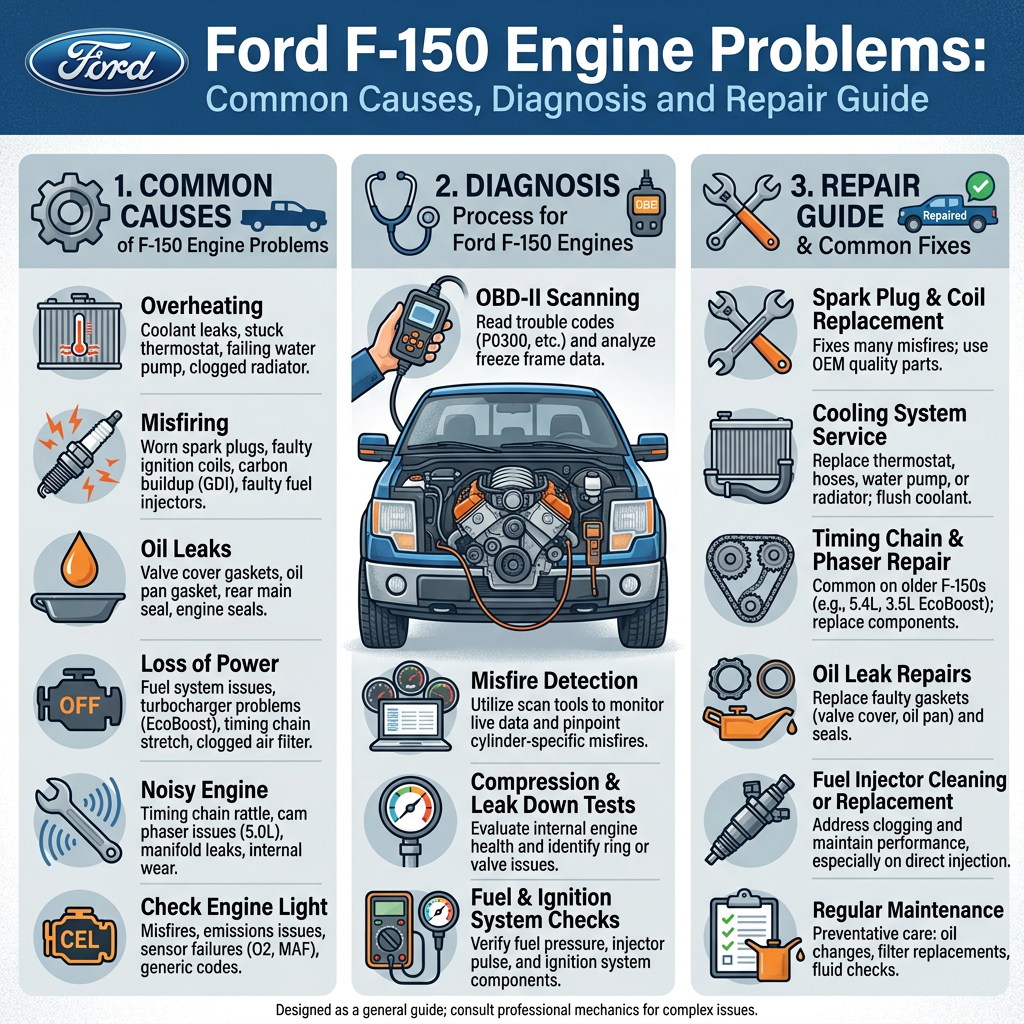
The Ford F-150 is a popular full-size pickup truck in the United States, used for daily driving, towing, construction work, farming, and long-distance travel. Like any vehicle, it can develop engine problems as it ages or accumulates mileage. Regular maintenance and early diagnosis can help prevent minor issues from becoming expensive repairs.
Common Ford F-150 engine problems include hard starting, engine overheating, rough idling, misfires, oil leaks, reduced engine power, and an illuminated check engine light. However, the causes can differ depending on the model year, engine configuration, mileage, and maintenance history.
This guide explains how to recognize common engine problems, perform basic diagnostic checks, and determine when professional repair is necessary.
1. Ford F-150 Engine Won’t Start
A Ford F-150 that refuses to start can have an electrical problem, a fuel delivery issue, or an engine-related fault. The first step is to identify what happens when you turn the ignition key or press the start button.
Common Symptoms
- The engine does not crank.
- The starter clicks repeatedly.
- The engine cranks but does not start.
- The engine starts and immediately stalls.
- The dashboard warning lights illuminate, but the engine remains off.
Possible Causes
A weak or discharged battery is a common reason for a no-start condition. Corroded battery terminals, loose electrical connections, a faulty starter motor, or a charging-system problem can also prevent normal starting.
If the engine cranks normally but does not start, possible causes include insufficient fuel pressure, an ignition problem on gasoline engines, a sensor fault, or an engine management issue.
Diesel-equipped F-150 models have different requirements. Depending on the engine and conditions, problems can involve fuel delivery, glow plugs, cold-start assistance, or diesel injection components.
Diagnostic and Repair Steps
- Check the battery condition and inspect its terminals for corrosion or loose connections.
- Observe whether the engine cranks normally or only produces a clicking sound.
- Check the fuel level and look for relevant warning messages.
- Scan the vehicle’s computer for diagnostic trouble codes when appropriate.
- Have the starter, charging system, fuel system, or ignition system tested according to the symptoms.
Do not repeatedly crank the engine for extended periods. If the starter overheats, stop and allow it to cool. Follow the owner’s manual for the correct jump-starting procedure.
2. Ford F-150 Engine Overheating
Engine overheating is a serious problem because excessive temperature can damage internal engine components. If the temperature gauge rises abnormally or a high-temperature warning appears, stop driving as soon as it is safe to do so.
Common Symptoms
- The engine temperature warning appears.
- Coolant leaks beneath the truck.
- Steam comes from the engine compartment.
- The heater produces unexpectedly cool air.
- The engine loses power or runs abnormally.
Possible Causes
Overheating may result from low coolant, a coolant leak, a malfunctioning thermostat, a damaged radiator, a faulty cooling fan, or a water pump problem. Restricted coolant flow and certain internal engine faults can also cause excessive temperatures.
The cooling-system design varies by model year and engine. Therefore, the correct diagnosis requires vehicle-specific service information.
How to Diagnose the Problem
First, park safely, switch off the engine, and allow it to cool completely. Never remove a radiator cap or pressurized coolant reservoir cap while the system is hot.
Once the engine is cold, inspect the coolant level according to the owner’s manual. Look for visible leaks around accessible hoses, the radiator, and the coolant reservoir. A workshop can perform a cooling-system pressure test and check the thermostat, fan operation, and water pump.
If overheating continues, do not keep driving the truck. Arrange professional inspection or towing to prevent major engine damage.
3. Rough Idling and Engine Vibration
A Ford F-150 that shakes while idling may have an air-fuel mixture problem, an ignition fault, a fuel delivery issue, or a mechanical problem.
Symptoms of Rough Idling
- The engine vibrates while the truck is stationary.
- Engine speed fluctuates unexpectedly.
- The truck shakes when the air conditioning is operating.
- Acceleration feels uneven.
- Fuel consumption increases.
Possible Causes
On gasoline engines, worn spark plugs, defective ignition coils, vacuum leaks, a dirty throttle body, or a malfunctioning sensor may contribute to rough idling. Fuel injector problems can also affect engine smoothness.
Engine mounts can cause noticeable vibration even when the engine itself is operating relatively normally. This distinction is important because replacing engine components will not correct a damaged mount.
Troubleshooting Steps
Begin by checking for warning lights and stored diagnostic codes. A scan tool may identify a misfire or a sensor-related fault. Inspect accessible intake hoses for damage and check whether recent maintenance could have left a connection loose.
Do not replace spark plugs, ignition coils, or sensors without confirming the likely cause. Some repairs require special tools or procedures, particularly on engines with difficult component access.
If the engine shakes severely, stalls repeatedly, or produces unusual mechanical noises, arrange a professional diagnosis.
4. Ford F-150 Engine Misfire
An engine misfire occurs when one or more cylinders fail to produce normal combustion. A misfire can reduce power, increase fuel consumption, and cause rough running.
Common Warning Signs
- The engine shakes during acceleration.
- The truck hesitates when climbing a hill.
- Acceleration becomes weak or inconsistent.
- The check engine light flashes.
- Fuel economy decreases.
What Causes an Engine Misfire?
On gasoline models, possible causes include worn spark plugs, faulty ignition coils, fuel injector problems, vacuum leaks, or low cylinder compression. Sensor faults and mechanical engine problems can also contribute.
A flashing check engine light may indicate an active misfire that can damage the catalytic converter. Reduce engine load and stop driving when it is safe to do so. If the flashing continues or the engine runs severely, arrange towing rather than continuing the journey.
Diagnosis and Repair
A technician can scan the vehicle for misfire codes, review available diagnostic data, and determine whether the problem affects a particular cylinder or multiple cylinders.
Depending on the findings, further tests may include ignition component testing, fuel pressure checks, injector testing, or compression and leak-down testing.
The correct repair depends on the test results. Replacing parts without identifying the underlying fault can increase repair costs without solving the problem.
5. Ford F-150 Oil Leaks and Low Oil Pressure
Engine oil lubricates moving parts, reduces friction, and helps carry heat away from internal components. An oil leak or low oil pressure condition should never be ignored.
Common Symptoms
- Oil spots appear under the truck.
- The engine oil level decreases between services.
- An oil warning light appears.
- Burning-oil smells come from the engine compartment.
- Smoke appears near hot engine components.
Possible Causes
Oil leaks can develop around seals, gaskets, the oil filter, the drain plug, or other engine components. The exact leak locations depend on the engine design and model year.
Low oil pressure is a different problem. It may result from an insufficient oil level, incorrect oil viscosity, a faulty pressure sensor, a restricted oil supply, or internal engine wear.
How to Check the Problem
Park on level ground and follow the owner’s manual procedure for checking the engine oil level. Inspect for visible leaks without touching hot or moving components.
If the oil pressure warning appears while the engine is running, stop safely and switch off the engine. Do not assume the problem is only a faulty sensor. Have the oil pressure and lubrication system checked before restarting.
Use the oil specification and viscosity recommended for the exact engine and model year.
6. Check Engine Light on a Ford F-150
The check engine light indicates that the engine management or emissions system has detected a condition requiring attention. It does not automatically mean that the engine needs replacement.
Common Reasons
- An ignition misfire.
- An emissions-system fault.
- An intake or sensor problem.
- A fuel system issue.
- A loose or damaged fuel cap on applicable configurations.
- A fault involving emissions-control equipment.
How to Diagnose It
A compatible OBD-II scan tool can retrieve diagnostic trouble codes. These codes help narrow down the possible causes, but they do not always identify the failed part directly.
For example, a code associated with an oxygen sensor may result from an actual sensor failure or another condition affecting the air-fuel mixture.
Record the codes before clearing them. Additional diagnostic testing may be necessary to identify the root cause.
A steady check engine light generally allows a cautious trip to a repair facility if the truck operates normally and no serious warning is present. A flashing light, severe shaking, overheating, or an oil pressure warning requires a more urgent response.
7. Reduced Engine Power and Poor Acceleration
Reduced engine power can make the Ford F-150 feel slow, especially when accelerating, climbing hills, or towing a trailer.
Potential Causes
Possible causes include restricted airflow, fuel delivery problems, ignition faults, sensor issues, or a problem with the electronic throttle system. Transmission problems can also feel similar to engine power loss.
On some models, the vehicle may enter a protective reduced-power mode after detecting a fault.
Troubleshooting
Check the dashboard for warning messages and scan for diagnostic codes. Inspect accessible air intake components for obvious damage or loose connections. A technician may need to test fuel pressure, intake readings, throttle operation, and other engine data.
Avoid towing heavy loads until the cause is understood. If the truck loses power suddenly in traffic, move to a safe location and seek assistance.
8. Ford F-150 Preventive Maintenance Tips
Regular maintenance can help reduce avoidable engine problems and extend the useful life of a pickup truck.
Follow the Correct Service Schedule
Use the maintenance schedule for the specific model year, engine, and operating conditions. Trucks used for frequent towing, heavy loads, dusty roads, or repeated short trips may require different maintenance considerations.
Change Engine Oil and Filter
Use oil that meets the manufacturer’s specifications. Follow the recommended service interval and check the oil level regularly, especially before long trips or demanding work.
Maintain the Cooling System
Check coolant condition and level when the engine is cold. Inspect for leaks and follow the manufacturer’s recommendations for coolant service. Never mix incompatible coolant types.
Replace Filters When Required
Inspect and replace the engine air filter according to the correct service schedule and operating conditions. Fuel filter requirements differ between gasoline and diesel configurations.
Pay Attention to Warning Signs
Unusual noises, persistent vibration, fluid leaks, difficult starting, or changes in engine performance should be investigated early.
Keep Diagnostic and Service Records
Record maintenance dates, mileage, repairs, and diagnostic findings. These records help identify recurring problems and can assist a technician when troubleshooting an intermittent fault.
9. When Should You Visit a Professional Mechanic?
Some basic checks, such as inspecting the oil level or looking for visible coolant leaks after the engine has cooled, can be performed by a vehicle owner. More complicated engine repairs require suitable tools, technical knowledge, and vehicle-specific service information.
Seek professional assistance if the truck has persistent overheating, low oil pressure, severe misfires, internal engine noises, repeated stalling, or unexplained loss of power.
Modern F-150 models may contain complex electronic controls and specialized engine components. Incorrect repairs can create additional faults or safety risks.
Before authorizing a major repair, ask the technician to explain the diagnostic findings, the proposed repair, and whether any additional testing is necessary read also/honda-activa-full-engine-fitting-step-by-step-installation-guide
Conclusion
Ford F-150 engine problems can range from a weak battery or minor intake issue to serious cooling-system, lubrication, ignition, or internal engine faults. Recognizing the symptoms early and following a systematic diagnostic process can help reduce unnecessary repairs.
The most important steps are to check warning lights, maintain correct oil and coolant levels, use appropriate diagnostic tools, and follow the service schedule for the specific truck.
Remember that the Ford F-150 has been produced with different engines and configurations over many model years. Always confirm the vehicle’s model year and engine type before choosing replacement parts or following a repair procedure. When a serious warning appears, prioritize safety and have the truck inspected by a qualified professional.
1 thought on “Ford F-150 Engine Problems: Common Causes, Diagnosis and Repair Guide”