The Hero Glamour 125 is a popular commuter motorcycle known for its practical performance, comfortable riding experience, and fuel-efficient engine. Like any motorcycle, however, the gear shifting system can develop problems over time. Riders may experience hard gear shifting, difficulty finding neutral, false neutral, a loose or stiff gear lever, gear slipping, or unusual noise during gear changes.
The good news is that every gear-shifting problem does not necessarily mean that the gearbox has to be opened. In many cases, the problem can be related to clutch adjustment, gear pedal position, engine oil condition, drive-chain tension, or the external gear-shift mechanism.
In this guide, we will explain how to inspect and adjust the Hero Glamour gear-shifting system step by step. We will also discuss common symptoms, maintenance procedures, possible causes of gear problems, and important precautions that can help keep the motorcycle’s transmission operating smoothly.
Important: Exact adjustment specifications can vary by Hero Glamour model year and version. Always confirm the specification in the motorcycle’s owner’s manual or service information before making a final adjustment.
Understanding the Hero Glamour Gear Shift System
Before adjusting the gear system, it is useful to understand how the mechanism works.
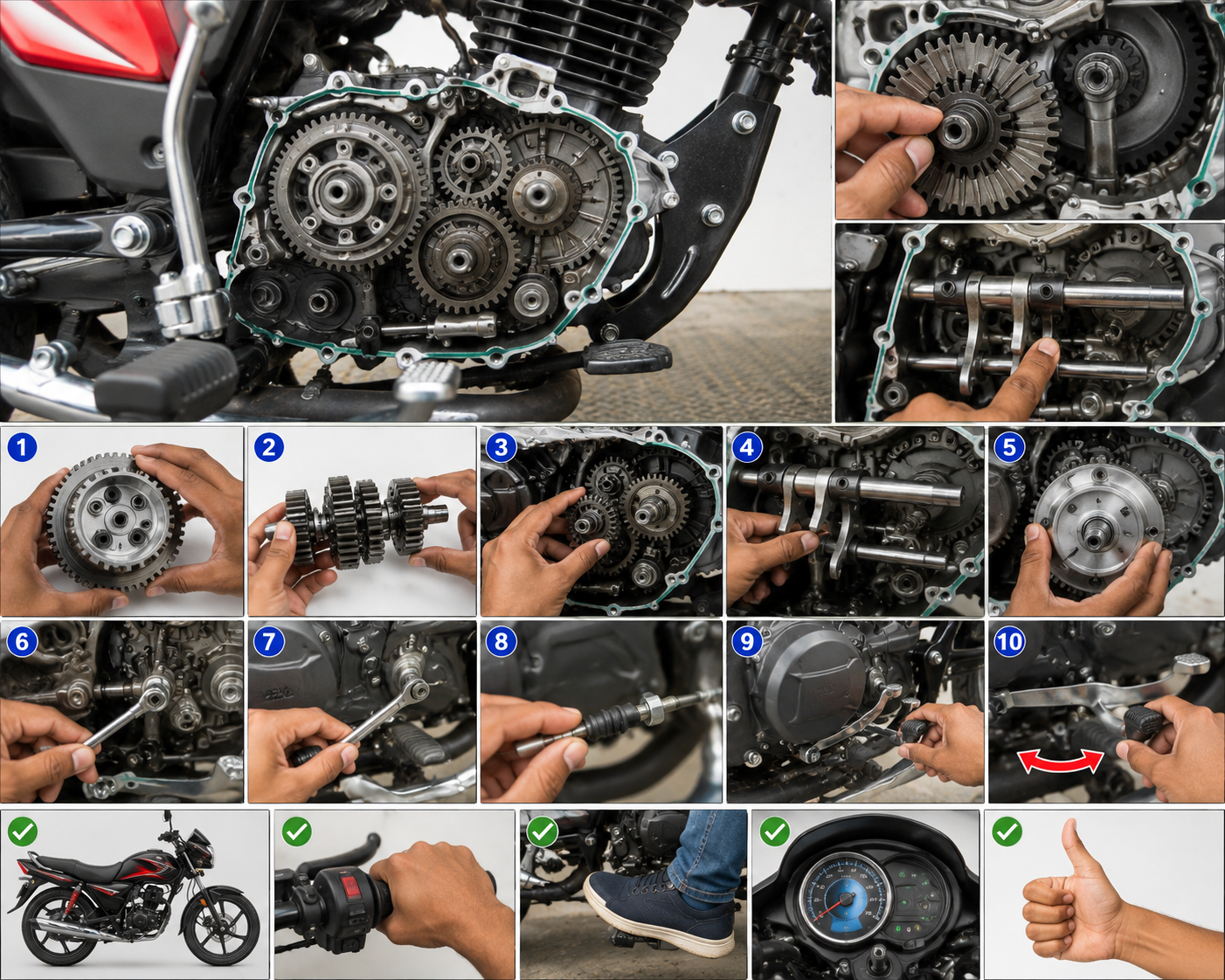
The Hero Glamour uses a sequential constant-mesh transmission. When the rider operates the gear pedal, the movement is transferred through the gear-shift shaft and selector mechanism to the shift drum. The shift drum controls the movement of the shift forks, which position the transmission components for the selected gear.
The clutch also plays an important role. When the clutch lever is operated, engine power is temporarily disconnected from the transmission, allowing the gears to change more smoothly.
If the clutch is not releasing correctly, the gear pedal or shift mechanism is damaged, the engine oil is unsuitable or badly degraded, or the chain is incorrectly adjusted, gear shifting can become difficult.
Main Components of the Gear-Shifting System
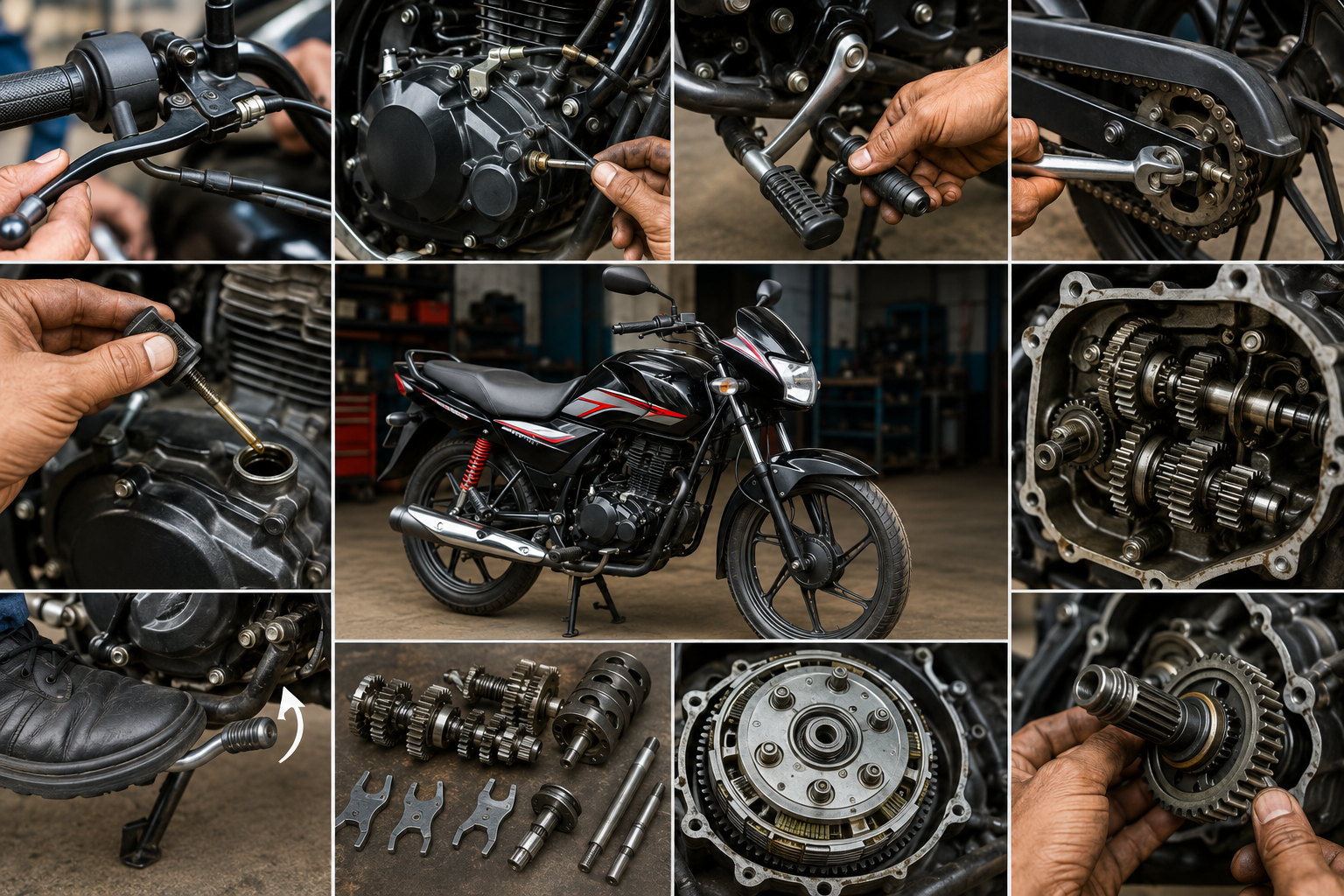
The external and internal parts involved in gear shifting include:
- Gear shift pedal
- Gear-shift shaft
- Selector mechanism
- Shift drum
- Shift forks
- Transmission gears
- Clutch assembly
- Drive chain
- Engine oil
- Return mechanism and springs
All these components must operate correctly for smooth gear changes.
Common Signs of a Gear-Shifting Problem
Before making an adjustment, identify the symptoms carefully.
1. Hard Gear Shifting
The gear lever requires excessive force or feels unusually stiff when changing gears.
2. Difficulty Finding Neutral
Neutral becomes difficult to select, especially when the motorcycle is stopped and the engine is running.
3. False Neutral
The transmission appears to enter a position between two gears, causing the engine to rev without normal power being delivered to the rear wheel.
4. Gear Slipping or Jumping Out
If the motorcycle unexpectedly comes out of gear during acceleration, there may be a problem inside the transmission. This should not be ignored.
5. Unusual Gearbox Noise
Grinding, knocking, or abnormal mechanical noise during gear changes may indicate a clutch, transmission, or selector-related problem.
6. Loose or Stiff Gear Pedal
A gear pedal that has excessive play, does not return properly, or feels unusually tight should be inspected.
Tools Required
Prepare the following basic tools before starting the inspection:
- Suitable spanners
- Screwdriver set
- Pliers
- Allen keys if required
- Clean cloth
- Suitable chain lubricant
- Correct motorcycle engine oil
- Torque wrench, if available
- Motorcycle service manual for model-specific specifications
Use clean and properly sized tools to prevent damage to bolts and fasteners.
Step-by-Step Hero Glamour Gear Setting and Inspection
Step 1 – Park the Motorcycle Safely
Park the motorcycle on a level surface.
Use the center stand where available and make sure the motorcycle is stable before beginning work.
Switch off the engine and allow hot components to cool before working around the engine and transmission.
Do not work underneath an unstable motorcycle.
Step 2 – Check the Clutch Lever Free Play
The clutch is one of the first things to inspect when gear shifting becomes difficult.
Operate the clutch lever several times and check its free play.
For many Hero motorcycles, clutch lever free play is commonly around 10–15 mm, but the exact specification should be confirmed for your particular Glamour model.
If the cable is adjusted too tightly, the clutch may remain partially disengaged and can slip.
If there is excessive free play, the clutch may not disengage completely, which can make gear shifting and neutral selection difficult.
How to Adjust
Use the clutch cable adjuster provided on the motorcycle.
Make small adjustments and repeatedly check the lever operation.
After adjustment, operate the clutch several times and confirm that the clutch engages and disengages smoothly.
Step 3 – Inspect the Gear Shift Pedal
Next, inspect the gear pedal.
The pedal should be positioned comfortably for the rider’s foot and should not touch the engine cover, footrest, or other components during operation.
If the pedal position is incorrect:
- Locate the gear lever mounting or pinch bolt.
- Loosen it using the correct tool.
- Remove or reposition the lever as required.
- Set the pedal to a comfortable position.
- Reinstall it correctly.
- Tighten the fastener securely according to the manufacturer’s specification.
Do not force the lever onto the shaft or strike it with a hammer.
Step 4 – Check Gear Pedal Movement
Move the gear pedal up and down by hand.
It should move smoothly and return correctly after operation.
If the pedal feels stiff:
- Inspect the pivot area.
- Remove dirt and mud.
- Check for rust.
- Inspect for excessive play.
- Lubricate the appropriate pivot point.
- Check the return mechanism.
If the shaft or return mechanism is damaged, professional repair may be necessary.
Step 5 – Check the Engine Oil
Engine oil is extremely important for motorcycles with a wet clutch and integrated transmission.
The same oil can lubricate several important components, including:
- Engine components
- Clutch assembly
- Transmission gears
- Bearings
- Internal shifting components
Old, contaminated, incorrect, or unsuitable oil can contribute to poor clutch operation and difficult gear shifting.
Check the oil level according to the procedure specified for your motorcycle.
Also inspect the oil for signs of contamination, unusual smell, or excessive degradation.
Use motorcycle engine oil that meets the manufacturer’s recommended viscosity and specification. If your particular model specifies 10W-30 and JASO MA/MA2, use oil meeting that requirement.
Do not select engine oil simply because it is suitable for a car; motorcycle wet-clutch requirements can be different.
Step 6 – Inspect the Drive Chain
The drive chain does not directly adjust the gearbox, but incorrect chain tension can affect power delivery, riding smoothness, and overall drivetrain operation.
Check the chain slack according to the motorcycle’s owner’s manual.
Do not assume one measurement applies to every Glamour model or every riding condition.
If the Chain Is Too Tight
An excessively tight chain can increase stress on:
- Chain and sprockets
- Wheel bearings
- Transmission output components
If the Chain Is Too Loose
A loose chain can cause:
- Jerky acceleration
- Chain noise
- Excessive movement
- Poor power delivery
Adjust the chain evenly on both sides and make sure the rear wheel remains properly aligned.
After adjustment, lubricate the chain with suitable chain lubricant.
Step 7 – Inspect the Gear-Shift Mechanism
Check the external gear-shift mechanism carefully.
Look for:
- Loose bolts
- Excessive play
- Bent components
- Damaged splines
- Rust
- Dirt accumulation
- Stiff movement
The gear-shift shaft should operate smoothly.
If the mechanism has excessive play or does not return properly, simply adjusting the clutch cable may not solve the problem.
Step 8 – Check the Clutch Operation
Pull the clutch lever and observe how the motorcycle behaves while selecting first gear.
With the clutch fully pulled in, the motorcycle should not try to move forward significantly.
If the motorcycle wants to creep forward strongly, the clutch may not be disengaging completely.
Possible causes include:
- Incorrect clutch cable adjustment
- Damaged clutch cable
- Clutch plate problems
- Incorrect clutch adjustment
- Internal clutch wear
If external adjustment does not correct the problem, the clutch assembly should be inspected.
Step 9 – Test All Gears
After completing the external inspections and adjustments, test the gear system carefully.
With the motorcycle in a safe area, check:
- First gear
- Second gear
- Third gear
- Fourth gear
- Fifth gear, if equipped
Each gear should engage positively without excessive force or abnormal grinding.
Pay particular attention to neutral selection and the transition between lower gears.
Never test a repaired motorcycle at high speed immediately.
Start slowly and make sure the braking, clutch, throttle, and transmission systems are operating correctly.
Why Proper Gear Adjustment Is Important
Correct adjustment and regular maintenance can provide several benefits.
Smooth Gear Shifting
A correctly adjusted clutch and properly maintained shift mechanism allow easier gear changes.
Better Riding Comfort
Smooth transmission operation is especially useful during frequent city riding and stop-and-go traffic.
Reduced Clutch Wear
Correct clutch free play helps prevent unnecessary clutch slipping.
Better Power Delivery
A correctly maintained drivetrain transfers engine power more effectively to the rear wheel.
Longer Component Life
Regular inspection can help identify worn cables, chains, pedals, and other components before they cause additional problems.
Common Causes of Hero Glamour Gear Problems
Before assuming that the gearbox is damaged, inspect the simpler causes first.
Common causes include:
- Incorrect clutch adjustment
- Worn clutch cable
- Old or unsuitable engine oil
- Incorrect chain tension
- Loose gear pedal
- Damaged gear-shift mechanism
- Bent gear lever
- Dry or contaminated pivot
- Worn clutch components
- Internal transmission wear
If the motorcycle continues to jump out of gear, produces serious internal noise, or repeatedly enters false neutral after external adjustments, the transmission should be inspected by a qualified mechanic.
Common Mistakes to Avoid
Avoid the following mistakes when working on the gear-shifting system:
Do Not Over-Tighten the Clutch Cable
The clutch needs correct free play. Excessive tightening can cause clutch slipping.
Do Not Ignore the Engine Oil
Delayed oil changes can affect engine, clutch, and transmission operation.
Do Not Use Unsuitable Oil
Always follow the manufacturer’s recommended motorcycle oil specification.
Do Not Ride With an Incorrectly Adjusted Chain
Both excessive chain slack and excessive tightness can cause drivetrain problems.
Do Not Force the Gear Lever
If a gear does not engage normally, do not use excessive force.
Do Not Ignore Gearbox Noise
Persistent grinding, knocking, or gear jumping requires further inspection.
Preventive Maintenance Tips
Regular maintenance can prevent many shifting problems.
- Check clutch free play during routine service.
- Inspect the gear pedal regularly.
- Keep the shift mechanism clean.
- Lubricate appropriate moving points.
- Maintain correct drive-chain slack.
- Lubricate the chain at suitable intervals.
- Replace engine oil according to the manufacturer’s service schedule.
- Inspect the clutch cable for damage or stiffness.
- Check the chain and sprockets for wear.
- Repair unusual transmission symptoms early.
Instead of waiting for a major problem, regular inspection is a much better way to protect the motorcycle.
When Should You Open the Gearbox?
External adjustment should always be checked first when the symptoms suggest a simple adjustment problem.
However, gearbox inspection may be necessary if:
- The motorcycle repeatedly jumps out of gear.
- False neutral continues after proper adjustment.
- There is severe internal transmission noise.
- A gear cannot be selected.
- The gear pedal does not operate the selector correctly.
- Internal selector components may be damaged.
- The motorcycle has suffered previous transmission damage.
Internal gearbox work requires proper tools, technical knowledge, and model-specific service information.
Do not open the engine unnecessarily if the problem can be solved through external inspection and adjustment.
Frequently Asked Questions
Why is my Hero Glamour difficult to shift into neutral?
Difficulty finding neutral can be related to clutch adjustment, engine oil condition, chain/drivetrain condition, or the shifting mechanism. Check the clutch adjustment and other external factors first.
What is the correct clutch free play?
A commonly used range is around 10–15 mm, but always confirm the exact specification for your particular Hero Glamour model and year.
Can engine oil affect gear shifting?
Yes. Oil condition and specification can influence clutch and transmission operation, especially on motorcycles using a wet clutch.
Why does my motorcycle jump out of gear?
Possible causes include incorrect shifting, worn transmission components, damaged gear dogs, selector problems, or other internal gearbox issues. Persistent gear jumping should be inspected by a qualified mechanic.
Why is my gear pedal stiff?
A stiff pedal can result from dirt, rust, a dry pivot, damaged external components, or an internal selector problem. Inspect the external mechanism before assuming gearbox damage.
How often should the gear pedal be lubricated?
Inspect it during routine servicing and lubricate the appropriate pivot when necessary, especially after riding through rain, mud, or dusty conditions. Follow the manufacturer’s maintenance recommendations.Read also repairing-bike-brakes-step-by-step-drum-disc-guide
Conclusion
A properly maintained gear-shifting system is essential for smooth, comfortable, and safe motorcycle operation. Hard shifting, difficulty finding neutral, false neutral, a stiff gear pedal, and unusual transmission behavior should not be ignored.
In many cases, the solution may be as simple as correcting clutch free play, checking the gear pedal position, inspecting the shift mechanism, maintaining correct chain tension, or replacing old engine oil with the correct motorcycle specification.
However, if the motorcycle continues to jump out of gear, produces serious internal noise, or shows persistent transmission problems after external adjustments, the gearbox and selector components should be inspected properly.
By following a regular maintenance routine and addressing small problems early, you can help maintain smooth gear changes and extend the working life of your Hero Glamour’s clutch and transmission system.
I hope this guide from Rajesh Technical Giyan helps you understand the Hero Glamour gear-shifting system and perform basic inspection and adjustment safely.
For more motorcycle repair guides, engine maintenance tutorials, troubleshooting articles, and practical automotive information, keep visiting Rajesh Technical Giyan.
Ride safely, maintain your motorcycle regularly, and keep your machine in good working condition.