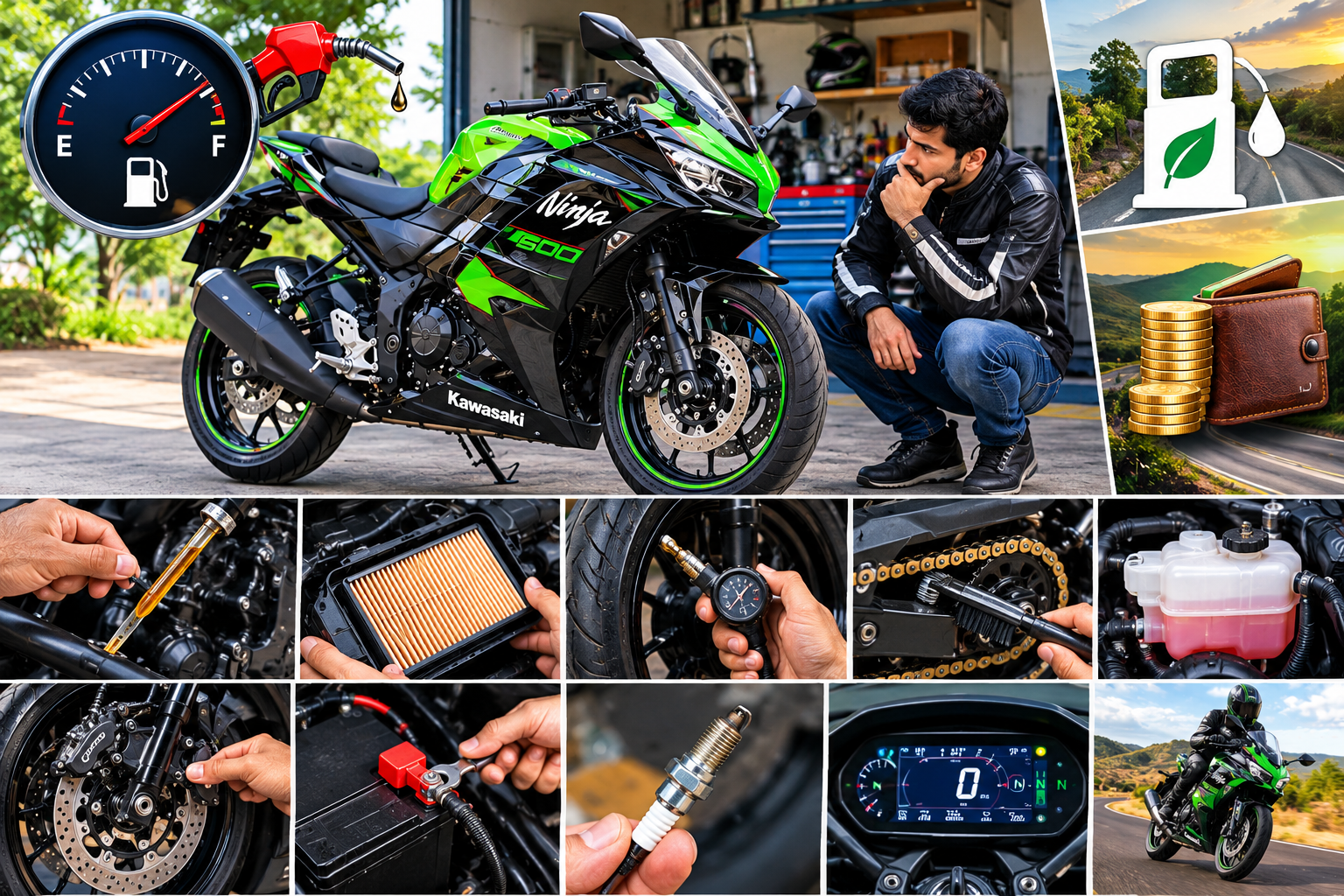
The Kawasaki Ninja 500 is designed to offer a balance between everyday usability and sportbike performance. Its 451cc liquid-cooled parallel-twin engine, fuel injection, six-speed transmission and relatively lightweight chassis make it capable of handling commuting, weekend rides and longer road trips.
However, fuel economy can vary significantly from one rider to another.
Some Ninja 500 owners may become concerned when their motorcycle uses more fuel than expected. In many cases, poor mileage does not automatically mean there is a major engine problem. Riding style, traffic, tire pressure, chain condition, maintenance, fuel-system condition and even weather can affect fuel consumption.
This guide explains the most common reasons a Kawasaki Ninja 500 may deliver disappointing fuel economy and how to systematically find the cause.
Understanding Ninja 500 Fuel Economy
Before diagnosing a mileage problem, it is important to understand that there is no single fuel-economy number that every Ninja 500 rider will achieve.
The motorcycle’s fuel consumption can change depending on:
- City or highway riding
- Average speed
- Acceleration habits
- Engine RPM
- Rider weight
- Passenger or luggage load
- Tire pressure
- Chain condition
- Weather
- Wind
- Road elevation
- Traffic
- Engine temperature
- Maintenance condition
- Fuel quality
The current U.S.-market Ninja 500 has a 3.7-gallon fuel tank and includes an Economical Riding Indicator in its electronic rider information. Kawasaki lists the motorcycle with a 451cc parallel-twin engine, dual 32mm throttle bodies, six-speed transmission and sealed-chain final drive.
That combination gives the Ninja 500 a useful range for everyday riding, but the actual distance per tank depends heavily on how the motorcycle is operated.
What Counts as a Mileage Problem?
A sudden reduction in fuel economy is more concerning than simply getting different fuel economy from another rider.
For example, if your motorcycle has always consumed fuel at a certain rate and suddenly begins using considerably more fuel under similar riding conditions, it is worth investigating.
Possible warning signs include:
- Fuel range suddenly decreases
- Fuel consumption becomes inconsistent
- Engine idle becomes rough
- Throttle response changes
- Starting becomes difficult
- Engine runs unusually hot
- Exhaust smell becomes unusually strong
- Check-engine warning appears
- Motorcycle feels slower than normal
- Engine RPM behaves differently
- Fuel consumption remains poor even during gentle riding
A small change from one tank to another does not necessarily indicate a mechanical fault.
Step 1: Calculate Your Actual Fuel Economy
Do not diagnose mileage problems by looking only at the fuel gauge.
The gauge is useful for estimating fuel level, but it is not a precise fuel-economy measurement.
A better method is to calculate your fuel economy over several tanks.
Basic Method
- Fill the tank consistently.
- Reset the trip odometer.
- Ride normally.
- Refill the tank.
- Record the amount of fuel added.
- Record the miles traveled.
- Calculate miles per gallon.
The basic formula is:
Miles ÷ Gallons Used = MPG
For example, if you ride 180 miles and use 3 gallons:
180 ÷ 3 = 60 MPG
Repeat the calculation over multiple tanks.
This reduces the effect of one unusual trip, such as heavy traffic or a long highway ride with strong headwinds.
Step 2: Check Your Riding Style
One of the biggest causes of poor motorcycle fuel economy is aggressive riding.
The Ninja 500 is a performance-oriented sport motorcycle. Its parallel-twin engine can provide strong acceleration, but repeatedly using high RPM and hard throttle openings will generally consume more fuel than smooth riding.
Frequent hard acceleration can reduce fuel economy quickly.
The following habits can increase fuel consumption:
- Rapid acceleration from every stop
- Frequent high-RPM riding
- Heavy braking followed by hard acceleration
- Staying in lower gears unnecessarily
- Repeated high-speed highway riding
- Riding aggressively through corners
- Rapid changes between acceleration and braking
This does not mean you need to ride extremely slowly.
Instead, focus on smooth throttle control and selecting the appropriate gear.
Step 3: Avoid Unnecessary High RPM
Engine speed has a major influence on fuel consumption.
The Ninja 500’s engine is designed to rev, but operating at high RPM continuously is different from occasionally using the engine’s performance.
If you spend most of a ride near the upper end of the tachometer, your fuel consumption will generally be higher than during moderate-speed riding.
On the highway, choose a gear that allows the engine to operate comfortably without unnecessarily high RPM.
The six-speed transmission gives the rider flexibility to select an appropriate ratio for different road conditions.
Step 4: Check Tire Pressure
Incorrect tire pressure is an easy-to-overlook cause of reduced efficiency.
Underinflated tires can increase rolling resistance, which means the engine has to work harder to move the motorcycle.
Before checking pressure, allow the tires to cool and use the pressure recommended by Kawasaki for your specific motorcycle.
Do not use the maximum pressure molded into the tire sidewall as a substitute for the motorcycle manufacturer’s recommended setting.
While Checking Tires, Inspect For:
- Uneven tread wear
- Cuts
- Cracks
- Bulges
- Embedded objects
- Abnormal wear patterns
If one tire repeatedly loses pressure, investigate the cause.
A slow puncture, damaged valve or wheel problem can create both a safety issue and a fuel-economy problem.
Step 5: Inspect the Drive Chain
The Ninja 500 uses a sealed chain final drive.
The chain is responsible for transferring engine power to the rear wheel.
A poorly maintained chain can affect the efficiency and smoothness of power transfer.
Check for:
- Excessive slack
- Tight spots
- Rust
- Dry links
- Damaged rollers
- Abnormal wear
- Poor lubrication
- Sprocket tooth wear
A chain that is too tight can create unnecessary mechanical resistance and stress.
A chain that is too loose can create poor power transfer, noise and accelerated wear.
Always follow Kawasaki’s specified chain slack and maintenance procedure for your exact model year.
Step 6: Check the Air Filter
The engine needs a proper supply of clean air for combustion.
If the air filter becomes excessively dirty or restricted, airflow can be affected.
A restricted air intake can contribute to poor engine response and may affect fuel economy.
Do not automatically replace the air filter simply because it looks slightly dirty.
Follow the maintenance schedule and inspect it according to Kawasaki’s recommendations.
If the motorcycle is used frequently in dusty conditions, the air filter may require more attention.
Step 7: Consider Engine Temperature
The Ninja 500 uses a liquid-cooled engine.
The cooling system helps maintain the engine within its intended operating temperature range.
If the engine is not reaching normal operating temperature or is running excessively hot, fuel economy and engine behavior can be affected.
Potential cooling-system problems can include:
- Low coolant
- Cooling-system leaks
- Radiator airflow restrictions
- Thermostat problems
- Cooling fan issues
- Faulty temperature sensors
Never open a hot cooling system.
If you notice overheating, repeated coolant loss or unusual temperature behavior, have the motorcycle inspected.
Step 8: Look for Fuel-System Problems
The Ninja 500 uses Kawasaki’s Digital Fuel Injection system with dual 32mm throttle bodies.
The fuel-injection system controls fuel delivery according to engine operating conditions.
A fuel-system problem can potentially cause poor fuel economy.
Possible areas requiring diagnosis include:
- Fuel injectors
- Throttle bodies
- Sensors
- Fuel pressure
- Electrical connections
- Intake leaks
- Engine-management faults
Do not replace injectors or sensors simply because fuel economy has decreased.
A proper diagnosis should determine whether the component is actually malfunctioning.
Step 9: Check for Intake Leaks
An intake leak can interfere with the air-fuel mixture and engine operation.
Inspect accessible intake connections for:
- Loose clamps
- Damaged hoses
- Cracked rubber components
- Disconnected lines
- Poorly seated components
Possible symptoms of an intake problem can include:
- Rough idle
- Hesitation
- Poor throttle response
- Unusual idle speed
- Poor fuel economy
If you suspect an intake leak, professional diagnosis may be necessary.
Step 10: Do Not Ignore the Check-Engine Light
A check-engine warning should never be ignored simply because the motorcycle still runs.
An engine-management fault can sometimes affect performance and fuel consumption.
The correct approach is to retrieve the relevant diagnostic information and investigate the underlying problem.
Do not assume that replacing the oxygen sensor, injector or another expensive component will automatically solve the issue.
A diagnostic code is a clue, not always a final diagnosis.
Step 11: Check the Brakes for Drag
A brake that does not release correctly can create resistance.
That resistance means the engine has to work harder to maintain speed.
Possible signs of brake drag include:
- Motorcycle feels unusually difficult to push
- One brake rotor becomes much hotter than expected
- Motorcycle does not roll freely
- Burning smell
- Reduced acceleration
- Abnormal brake-pad wear
Brake problems are safety-critical.
If you suspect a dragging brake, have it inspected rather than continuing to ride and hoping the problem disappears.
Step 12: Check Wheel and Bearing Condition
Wheel bearings allow the wheels to rotate smoothly.
A damaged bearing can create resistance, noise or abnormal wheel movement.
Possible warning signs include:
- Grinding noise
- Rough wheel rotation
- Excessive play
- Unusual vibration
- Wheel-area noise
Wheel-bearing problems should not be ignored.
They are not simply fuel-economy issues; they can also become safety problems.
Step 13: Watch Your Highway Speed
Highway riding does not automatically produce excellent fuel economy.
At higher speeds, aerodynamic drag increases significantly.
A sportbike may feel comfortable at highway speeds, but increasing speed can increase the amount of power required to push the motorcycle through the air.
This means a rider traveling at a moderate highway speed may use less fuel than a rider traveling substantially faster, even when both motorcycles are mechanically identical.
Wind direction also matters.
A strong headwind can increase aerodynamic resistance and reduce fuel economy.
Step 14: Reduce Unnecessary Weight
Additional weight can affect fuel consumption.
Heavy luggage, accessories and carrying unnecessary equipment can increase the work required to accelerate the motorcycle.
This does not mean you should remove useful safety equipment.
Instead, avoid carrying unnecessary weight when it is not required.
For touring riders, pack intelligently and keep heavier items properly secured.
Step 15: Check Your Riding Environment
A motorcycle used primarily in stop-and-go traffic can consume fuel differently from one used on open roads.
City riding often involves:
- Frequent stops
- Frequent acceleration
- Engine idling
- Low-speed operation
- Traffic congestion
- Short trips
Short trips can also prevent the motorcycle from spending as much time operating under normal conditions.
If your Ninja 500 is used almost entirely in heavy urban traffic, lower fuel economy compared with a rider who spends more time on open roads may be completely normal.
Step 16: Avoid Excessive Idling
Letting the engine run while the motorcycle is stationary uses fuel without moving the motorcycle.
Long periods of unnecessary idling can therefore reduce fuel economy.
If you are stopped for an extended period and conditions allow, follow safe and appropriate practices rather than keeping the motorcycle running unnecessarily.
Never switch off the motorcycle in situations where doing so could create a traffic or safety problem.
Step 17: Use the Economical Riding Indicator
The Ninja 500 includes an Economical Riding Indicator.
This feature can help the rider understand when riding conditions are favorable for fuel-efficient operation.
It should be treated as a guide rather than a guarantee of a particular MPG figure.
The rider still controls:
- Throttle input
- Gear selection
- Speed
- Acceleration
- Braking
Learning to ride smoothly is more important than constantly trying to chase an indicator.
Step 18: Check Fuel for Possible Problems
Always use fuel appropriate for the motorcycle and follow Kawasaki’s fuel recommendations.
If fuel economy suddenly changes after refueling, consider whether the difference could be related to fuel quantity, riding conditions or measurement method before assuming the fuel itself is defective.
If you repeatedly experience poor running, hesitation or starting problems after refueling, document the symptoms and have the motorcycle checked.
Step 19: Follow the Maintenance Schedule
Routine maintenance is one of the most important ways to protect fuel economy.
Maintenance should include the items specified in the owner’s manual for your particular model year.
Depending on the maintenance schedule, this can involve checking or servicing:
- Engine oil
- Oil filter
- Air filter
- Spark plugs
- Drive chain
- Coolant
- Brakes
- Tires
- Battery
- Throttle operation
- Cables and controls
Do not assume that a motorcycle is properly maintained simply because it starts and runs.
Small problems can develop gradually before they become obvious.
Step 20: When Poor Mileage Could Indicate a Serious Problem
Poor fuel economy deserves more attention when it appears together with other symptoms.
Be especially cautious if you notice:
- Strong fuel smell
- Visible fuel leakage
- Black or unusual exhaust smoke
- Severe hesitation
- Rough running
- Repeated stalling
- Overheating
- Oil contamination
- Coolant loss
- Check-engine warning
- Sudden major fuel-consumption increase
These symptoms can indicate a mechanical, fuel, ignition, cooling or electronic problem.
At that point, continuing to ride simply to test the mileage may not be the best decision.
A Simple Ninja 500 Mileage Troubleshooting Checklist
If your fuel economy seems worse than normal, work through the problem systematically.
First
Check how you calculated MPG.
Make sure the mileage and fuel quantity were recorded correctly.
Second
Think about recent riding conditions.
Ask yourself:
- Have I been riding faster?
- Has traffic become heavier?
- Have I been using more high RPM?
- Am I carrying additional weight?
- Has the weather changed?
- Have I been riding into strong wind?
Third
Inspect the easy mechanical items.
Check:
- Tire pressure
- Chain condition
- Oil level
- Coolant level
- Air filter condition
- Brake drag
- Visible leaks
Fourth
Look for electronic or engine symptoms.
Check for:
- Warning lights
- Rough idle
- Poor throttle response
- Difficult starting
- Unusual engine noise
Fifth
Get professional diagnosis when necessary.
If the problem remains after basic checks, avoid replacing expensive components based on guesses.
How to Improve Ninja 500 Fuel Economy
For most riders, the simplest improvements are riding and maintenance habits.
Ride Smoothly
Use progressive throttle input rather than repeatedly opening the throttle aggressively.
Select the Right Gear
Use the six-speed gearbox to keep the engine operating comfortably.
Maintain Correct Tire Pressure
Check pressure regularly with a reliable gauge.
Maintain the Chain
Keep the chain adjusted, lubricated and inspected according to Kawasaki’s recommendations.
Keep the Engine Properly Serviced
Follow the manufacturer’s maintenance schedule.
Avoid Unnecessary High-Speed Riding
Higher speed generally requires more aerodynamic power.
Remove Unnecessary Weight
Carry what you need rather than unnecessary luggageRead also hero-cd-dawn-bs4-repair-guide
Final Thoughts
A Kawasaki Ninja 500 that seems to have poor mileage does not necessarily have an engine problem.
Fuel economy is affected by many factors, and sportbike riders can see significant differences depending on riding style, speed, traffic, tire pressure, chain condition, maintenance and weather.
The best approach is to diagnose the situation instead of immediately replacing parts.
Start by calculating your actual MPG over several tanks. Then check riding conditions, tire pressure, chain condition, air filter, brakes and basic fluid levels. If the motorcycle also has rough running, fuel smell, overheating, warning lights or other unusual symptoms, move toward proper mechanical diagnosis.
The Ninja 500’s 451cc parallel-twin engine is designed to provide both usable everyday performance and sportbike character. Good maintenance and smooth riding can help you get the most practical fuel economy from that engine without sacrificing the reason many riders choose a Ninja in the first place.
Remember that fuel economy should be measured over time rather than judged from a single tank. If your mileage gradually changes, investigate the cause. If it suddenly drops dramatically or appears alongside mechanical symptoms, do not ignore it.
A systematic approach can help separate normal fuel-consumption variation from a genuine motorcycle problem—and that can save both fuel and unnecessary repair costs.