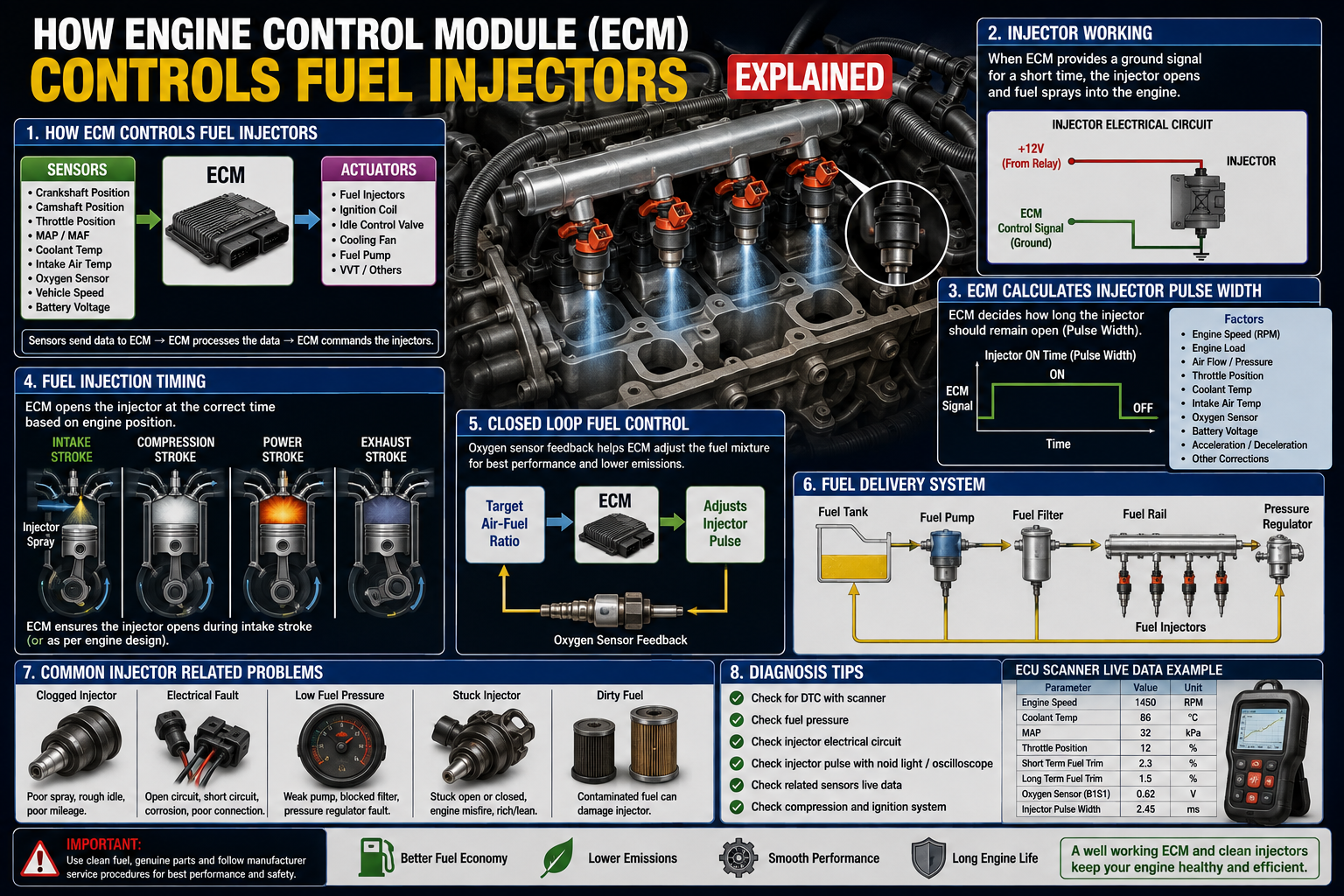
Modern fuel-injected engines use an electronic control system to manage fuel delivery, ignition, emissions, engine performance, and many other functions. At the center of this system is the Engine Control Module, commonly called the ECM.
The ECM continuously receives information from different sensors installed throughout the engine and vehicle. It processes this information and then controls components such as the fuel injectors according to programmed operating strategies.
Understanding this system is very useful when diagnosing problems such as difficult starting, rough idling, poor acceleration, excessive fuel consumption, engine misfires, and injector-related faults.
The exact control strategy can vary between manufacturers and engine designs, but the basic principle remains similar.
1. What Is an Engine Control Module?
The Engine Control Module is an electronic computer that manages important engine functions.
Depending on the vehicle, it may control or coordinate:
- Fuel injection
- Ignition timing
- Idle control
- Emission systems
- Throttle operation
- Cooling fan operation
- Variable valve timing
- Turbocharger control
- Diagnostic functions
The ECM receives electrical signals from sensors, processes those signals, and sends commands to actuators.
The fuel injector is one of the most important actuators controlled by the ECM.
In simple terms:
Sensors provide information → ECM processes information → ECM commands the injectors → Injectors deliver fuel.
2. What Does a Fuel Injector Do?
A fuel injector is an electronically controlled valve that delivers fuel into the engine’s intake system or combustion chamber, depending on the engine design.
When the injector receives an appropriate electrical command, it opens for a very short period.
Fuel is then delivered through the injector.
The amount of fuel delivered depends on several factors, including:
- Injector flow characteristics
- Fuel pressure
- Injector opening time
- Engine operating conditions
- ECM control strategy
The ECM therefore does not simply tell the injector to “send fuel.”
It carefully controls when the injector opens and how long it remains open.
3. How Does the ECM Know How Much Fuel the Engine Needs?
The ECM uses information from several sensors.
Common inputs include:
- Engine speed
- Engine load
- Intake air pressure or airflow
- Throttle position
- Engine coolant temperature
- Intake air temperature
- Oxygen or air-fuel-ratio sensor feedback
- Crankshaft position
- Camshaft position
- Vehicle speed
- Battery voltage
The exact sensors depend on the engine.
For example, when the driver opens the throttle, the ECM needs to know how much air is entering the engine and how the engine is responding.
It then calculates an appropriate fuel command.
4. Crankshaft Position Sensor
The crankshaft position sensor is extremely important.
It provides the ECM with information about crankshaft position and engine speed.
The ECM needs to know where the crankshaft is before it can accurately control fuel injection and ignition.
If the ECM cannot obtain a valid crankshaft-position signal, many engines may not start because the control system cannot properly synchronize engine operation.
A faulty crankshaft sensor or its wiring can therefore produce symptoms such as:
- No-start condition
- Intermittent stalling
- Misfiring
- Difficult starting
- Loss of engine speed information
5. Camshaft Position Sensor
The camshaft position sensor provides information about camshaft position.
The ECM can use this information to determine engine phase and synchronize injection and ignition events.
On engines using sequential fuel injection, camshaft information can be particularly important for identifying which cylinder is ready for its injection event.
A camshaft sensor problem can produce starting difficulties, poor engine performance, warning lights, or synchronization-related diagnostic trouble codes.
6. Throttle Position Sensor
The throttle position sensor tells the ECM how far the throttle is open.
When the throttle opening changes, the ECM can recognize a change in driver demand.
For example, when the rider or driver opens the throttle quickly, the engine requires a corresponding change in fuel delivery.
The ECM combines throttle information with other sensor inputs rather than relying on the throttle sensor alone.
A faulty throttle-position signal can cause:
- Poor acceleration
- Unstable idle
- Hesitation
- Incorrect fueling
- Warning lights
7. MAP and MAF Sensors
Depending on the engine, the ECM may use a MAP sensor, a MAF sensor, or another method to estimate engine airflow and load.
MAP Sensor
MAP stands for Manifold Absolute Pressure.
The MAP sensor measures pressure inside the intake manifold.
The ECM can use this information to estimate engine load.
MAF Sensor
MAF stands for Mass Air Flow.
A MAF sensor measures the mass of air entering the engine.
The ECM can use this information to calculate the amount of fuel required.
Not every engine uses both sensors.
8. Engine Coolant Temperature Sensor
Engine temperature significantly affects fuel requirements.
A cold engine generally needs different fueling compared with an engine that has reached normal operating temperature.
The coolant temperature sensor provides the ECM with engine-temperature information.
During cold starting and warm-up, the ECM can modify fuel delivery accordingly.
If the temperature signal is incorrect, the ECM may calculate an inappropriate fuel mixture.
Possible symptoms can include:
- Difficult cold starting
- Poor fuel economy
- Rough idle
- Excessive emissions
- Cooling-fan-related issues
9. Intake Air Temperature Sensor
Air density changes with temperature.
The intake air temperature sensor provides the ECM with information about the temperature of incoming air.
The ECM can combine this information with airflow or pressure data to improve its fueling calculations.
A faulty temperature signal can therefore affect fuel delivery and engine performance.
10. Oxygen Sensor Feedback
Many modern engines use oxygen sensors or air-fuel-ratio sensors in the exhaust system.
These sensors provide information about combustion and exhaust oxygen content.
The ECM can use this feedback to adjust fuel delivery.
This is especially important during closed-loop operation.
If the mixture is too rich or too lean, the ECM can make adjustments within its control range.
This feedback system helps improve fuel economy and emissions.
11. Open-Loop and Closed-Loop Fuel Control
Fuel control can broadly be explained using two operating strategies.
Open Loop
In open-loop operation, the ECM primarily relies on calculated values and sensor inputs without using oxygen-sensor feedback to continuously correct the mixture.
This can occur during certain starting, warm-up, high-load, or other operating conditions depending on the engine strategy.
Closed Loop
In closed-loop operation, the ECM uses oxygen or air-fuel-ratio sensor feedback to adjust fueling.
The ECM compares the sensor information with its target and makes appropriate corrections.
This allows the system to compensate for certain changes in operating conditions and component behavior.
12. What Is Injector Pulse Width?
One of the most important concepts in electronic fuel injection is injector pulse width.
Pulse width refers to the amount of time the injector is commanded to remain open during an injection event.
For example, the ECM may command an injector to open for a very short period during one operating condition and for a longer period under another condition.
Generally, greater fuel demand can require a longer injector opening duration, although actual fuel delivery also depends on fuel pressure, injector characteristics, and the overall control strategy.
The ECM continuously calculates and adjusts this command.
13. How the ECM Activates an Injector
A typical injector has an electrical circuit that allows the ECM to control it.
The injector receives electrical power through the vehicle’s electrical system, while the ECM controls the injector circuit according to the system design.
When the ECM commands the injector, the injector’s internal electromagnetic mechanism moves and allows fuel to pass.
When the command ends, the injector closes.
This process happens extremely quickly.
During normal engine operation, the ECM can command multiple injector events every second.
14. Fuel Pressure Is Also Important
The ECM controls the injector electrically, but the ECM does not create the fuel pressure.
Fuel pressure is produced by the vehicle’s fuel-delivery system.
Depending on the vehicle, the system may include:
- Fuel tank
- Fuel pump
- Fuel filter
- Fuel rail
- Pressure regulator
- Fuel injectors
- Fuel lines
If fuel pressure is too low, an injector may receive a correct electrical command but still deliver insufficient fuel.
Therefore, an injector fault should never be diagnosed only by checking the electrical signal.
Fuel pressure must also be considered.
15. ECM Fuel Calculation
The ECM uses a combination of sensor information and programmed maps or calculations.
A simplified example is:
Engine speed + engine load + temperature + throttle position + oxygen feedback + other corrections = injector command
The actual control algorithm is much more sophisticated.
The ECM may also apply corrections for:
- Battery voltage
- Acceleration
- Deceleration
- Cold starting
- Engine temperature
- Atmospheric conditions
- Fuel-system behavior
- Emission requirements
This allows the engine to operate under many different conditions.
16. Fuel Injection During Engine Starting
Starting an engine requires a specific fueling strategy.
When the starter motor turns the engine, the ECM receives crankshaft-position information.
It then determines engine speed and position and commands the appropriate injection events.
Cold starting may require additional fuel compared with a warm engine.
If the ECM does not receive essential sensor information, or if fuel pressure is inadequate, the engine may crank without starting.
This is why a no-start diagnosis should include electrical, fuel, sensor, and mechanical checks.
17. Fuel Injection During Acceleration
When the throttle is opened, the ECM detects changes in engine operating conditions.
It may increase fuel delivery to match the additional air entering the engine.
The ECM considers multiple inputs rather than simply increasing injector opening time based on throttle position.
This coordinated control helps produce smooth acceleration.
If an engine hesitates during acceleration, possible causes can include sensor problems, insufficient fuel pressure, injector problems, ignition faults, intake leaks, or mechanical issues.
18. Fuel Injection During Deceleration
During certain deceleration conditions, some engines can reduce or temporarily stop fuel injection.
This strategy is commonly called deceleration fuel cut and can help reduce fuel consumption and emissions.
The exact conditions for fuel cut vary by engine.
The ECM considers factors such as:
- Engine speed
- Throttle position
- Engine temperature
- Vehicle operating conditions
When conditions change, fuel injection resumes according to the programmed strategy.
19. What Happens When an Injector Becomes Dirty?
A dirty injector may not deliver fuel correctly.
Deposits or contamination can affect the injector’s spray pattern or flow.
Possible symptoms include:
- Rough idle
- Poor acceleration
- Misfire
- Increased fuel consumption
- Difficult starting
- Uneven engine operation
However, these symptoms can also be caused by many other problems.
Therefore, injector cleaning should not be performed simply because the engine is running poorly.
Proper diagnosis should come first.
20. Electrical Testing of a Fuel Injector
When diagnosing an injector, a technician may inspect the electrical circuit.
Depending on the system, checks can include:
- Injector resistance
- Power supply
- Wiring continuity
- Connector condition
- ECM control signal
- Short circuits
- Open circuits
A test light, multimeter, oscilloscope, or suitable diagnostic equipment may be used depending on the fault.
Always follow the manufacturer’s testing procedure because injector circuits can differ significantly between vehicles.
21. Using a Diagnostic Scanner
A diagnostic scanner can provide valuable information when an electronically controlled engine develops a fault.
The ECM may store diagnostic trouble codes when it detects a problem.
A scanner can sometimes display:
- Engine fault codes
- Engine RPM
- Coolant temperature
- Throttle position
- Fuel trims
- Sensor values
- Misfire information
- Other live data
However, a diagnostic trouble code is not always a direct instruction to replace a particular component.
For example, an injector-related code could result from an injector problem, wiring problem, connector issue, power-supply problem, or ECM control issue.
Diagnosis must identify the actual cause.
22. Fuel Trim Explained Simply
Fuel trim describes adjustments the ECM makes to fueling based on feedback and its calculated target.
Two common terms are:
- Short-Term Fuel Trim
- Long-Term Fuel Trim
Short-term adjustments can change relatively quickly.
Long-term adjustments represent learned corrections over time.
Large fuel-trim deviations can indicate problems such as:
- Vacuum leaks
- Incorrect fuel pressure
- Injector flow problems
- Airflow measurement issues
- Exhaust leaks affecting sensor readings
- Other engine conditions
Fuel-trim data should always be interpreted together with other diagnostic information.
23. What Happens If the ECM Cannot Control an Injector Correctly?
If the ECM detects certain injector or circuit problems, it may store a diagnostic trouble code and turn on the malfunction indicator lamp.
Depending on the fault and engine design, the ECM may modify engine operation or disable certain functions to protect the engine or emissions system.
A severe injector problem can cause:
- Misfire
- Poor performance
- Increased emissions
- Difficult starting
- Engine stalling
- Potential engine damage in certain circumstances
Continuing to drive with a severe misfire is not recommended.
24. Common Injector-Related Problems
Some common injector-related problems include:
Injector Clogged
Restricted fuel flow can cause a lean condition or cylinder imbalance.
Injector Stuck Closed
The cylinder may receive little or no fuel.
Injector Stuck Open
Excessive fuel can enter the engine, potentially causing severe running problems.
Electrical Circuit Fault
Broken wiring, poor connectors, short circuits, or other electrical faults can prevent proper injector operation.
Low Fuel Pressure
The injector may operate electrically but fail to deliver the expected amount of fuel.
ECM Control Problem
In some cases, the ECM circuit or control strategy itself may be involved.
25. How to Diagnose an Injector Problem
A professional diagnostic process should be systematic.
Start with the complaint and stored diagnostic codes.
Then inspect:
- Battery condition
- Fuel level
- Fuel pressure
- Injector wiring
- Injector connectors
- Injector electrical condition
- ECM control signal
- Sensor inputs
- Engine compression
- Ignition system
This prevents unnecessary parts replacement.
For example, replacing an expensive injector will not solve a problem caused by low fuel pressure or a damaged wiring harness.
26. Why Battery Voltage Matters
The injector is an electrical actuator.
Battery and charging-system voltage can influence electrical components and injector operation.
Modern ECM systems can compensate for some voltage variations, but an unstable electrical supply can create unusual symptoms.
Therefore, during diagnosis, check the battery and charging system if electrical problems are suspected.
27. Why Engine Compression Still Matters
Electronic fuel injection cannot compensate for every mechanical problem.
If a cylinder has low compression because of worn piston rings, valve leakage, or another mechanical fault, the ECM may still command the injector normally.
The engine can continue to run poorly despite correct electronic commands.
This is an important diagnostic principle:
A correct injector command does not prove that the engine itself is mechanically healthy.
28. Preventing Injector and Fuel-System Problems
Good maintenance can reduce the risk of fuel-system problems.
Important practices include:
- Use appropriate fuel
- Keep the fuel system clean
- Replace fuel filters when required
- Maintain the correct fuel pressure
- Follow the manufacturer’s service schedule
- Avoid contaminated fuel
- Repair warning lights promptly
- Keep electrical connectors clean and secure
Do not use fuel-system additives unnecessarily. If an additive is used, make sure it is suitable for the particular fuel system and follow the manufacturer’s recommendations.Read also honda-activa-piston-ring-installation
Conclusion
The Engine Control Module is the central computer responsible for coordinating fuel injection with many other engine functions.
It does not simply switch the fuel injectors on and off randomly. Instead, it receives information from sensors such as the crankshaft position sensor, camshaft position sensor, throttle position sensor, airflow or manifold-pressure sensors, temperature sensors, and oxygen or air-fuel-ratio sensors.
The ECM processes this information and calculates an appropriate injector command for the current operating condition.
The injector then opens for a precisely controlled period, allowing fuel to enter the engine.
Understanding this relationship between sensors, ECM, fuel pressure, injector operation, and engine mechanics is extremely important for accurate troubleshooting.
If a motorcycle or car has a starting problem, poor acceleration, rough idle, high fuel consumption, or an injector-related diagnostic code, do not immediately replace the injector or ECM. First perform a systematic diagnosis.
Check the electrical supply, sensor signals, fuel pressure, injector circuit, mechanical condition, and diagnostic data.
Always follow the service information for the exact vehicle because fuel-injection systems vary between manufacturers and engine designs.
I hope this How Engine Control Module (ECM) Controls Fuel Injectors Explained guide helps motorcycle mechanics, automotive technicians, DIY enthusiasts, and vehicle owners understand how modern electronic fuel injection works.
For more practical motorcycle repair guides, car troubleshooting, engine diagnostics, fuel-injection information, and workshop knowledge, keep visiting Rajesh Technical Giyan.