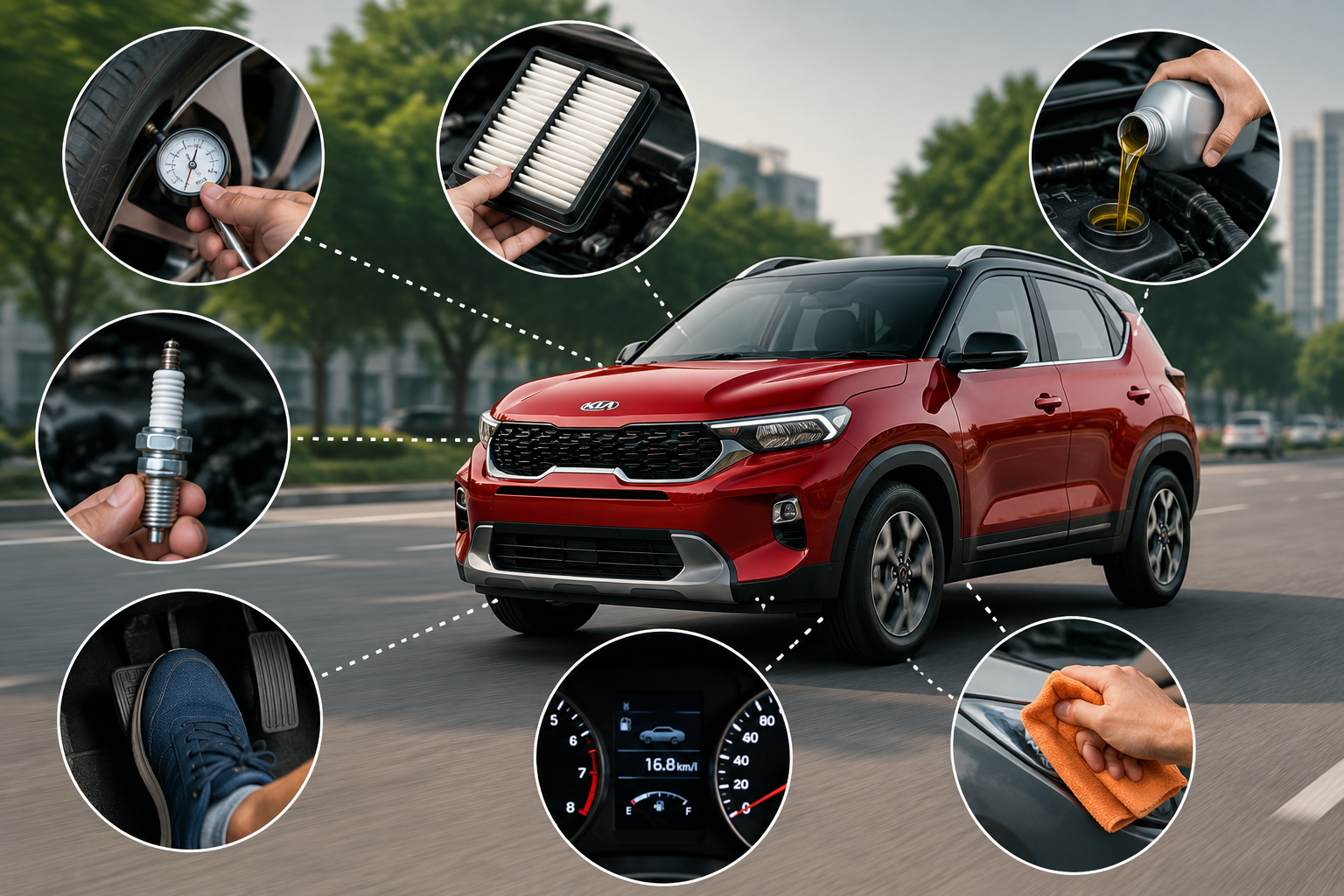
In this guide, we will share actionable tips to improve the mileage of your Kia Sonet
Today, I will explain some practical Kia Sonet mileage improvement tips that can help owners improve fuel efficiency and reduce unnecessary fuel consumption. Whether you drive a petrol, diesel, manual, iMT, or automatic version, the basic principles of improving mileage remain similar: maintain the vehicle correctly, drive smoothly, avoid unnecessary idling, and make sure the engine and tyres are operating properly.
Mileage can vary considerably depending on traffic conditions, road conditions, driving style, vehicle load, air-conditioning usage, tyre pressure, fuel quality, and the condition of the engine and transmission. Therefore, there is no single trick that can dramatically increase mileage overnight. Consistent maintenance and efficient driving habits are the real keys to better fuel economy.
1. Maintain the Correct Tyre Pressure
One of the easiest ways to improve Kia Sonet fuel economy is to maintain the recommended tyre pressure.
When tyre pressure is too low, the tyres have greater rolling resistance. This forces the engine to work harder to move the vehicle and can increase fuel consumption.
Check the tyre pressure regularly, especially before long journeys.
Do not use an unnecessarily high tyre pressure simply to improve mileage. Always follow the recommended tyre-pressure specification provided for your particular Kia Sonet and tyre setup.
Also inspect the tyres for uneven wear. Uneven wear can sometimes indicate incorrect wheel alignment, suspension problems, or incorrect tyre pressure.
2. Drive Smoothly Instead of Aggressively
Aggressive acceleration is one of the common reasons for poor fuel economy.
Repeatedly accelerating hard and then braking heavily wastes energy. In city traffic, this driving style can significantly reduce efficiency.
Try to accelerate progressively.
Instead of suddenly pressing the accelerator, increase throttle input smoothly and allow the vehicle to build speed naturally.
Similarly, look ahead and anticipate traffic. If you can see a red light or slow-moving traffic ahead, gradually reduce speed instead of accelerating hard and then braking immediately.
Smooth driving helps reduce unnecessary fuel consumption.
3. Avoid Excessive Engine Idling
Leaving the engine running while the vehicle is stationary consumes fuel without moving the vehicle.
For example, if you are waiting for someone for an extended period or are stopped for a long time in a safe location, unnecessary idling can reduce overall fuel economy.
However, do not repeatedly switch the engine off and restart it for very short stops where doing so is inappropriate or unsafe.
Use practical judgment based on traffic conditions, safety, weather, and your vehicle’s operating requirements.
4. Use the Air Conditioner Wisely
The air conditioner places an additional load on the engine.
During extremely hot weather, completely avoiding the AC may not be practical, especially in India. Instead, use it efficiently.
Before starting a journey, if the car has been parked in direct sunlight, ventilate the cabin briefly when appropriate and safe. Once the cabin temperature begins to come down, use a comfortable temperature setting rather than continuously operating the system at maximum cooling.
Keep the AC system properly maintained.
A dirty cabin air filter can restrict airflow and make the climate-control system work less efficiently.
5. Replace the Air Filter When Required
The engine requires a proper supply of clean air for efficient combustion.
A severely dirty engine air filter can restrict airflow and affect engine performance.
During routine servicing, inspect the air filter according to the manufacturer’s recommended maintenance schedule and replace it when necessary.
Do not replace the filter excessively early simply because you are trying to increase mileage. The correct replacement interval depends on operating conditions, dust levels, driving environment, and the manufacturer’s recommendations.
Vehicles regularly driven in dusty areas may require more frequent inspection.
6. Keep the Engine Properly Serviced
Regular maintenance is one of the most important factors in maintaining fuel efficiency.
Follow the recommended service schedule for your Kia Sonet.
Important maintenance areas can include:
- Engine oil
- Oil filter
- Air filter
- Spark plugs on applicable petrol engines
- Fuel system
- Coolant
- Transmission system
- Brake system
- Tyres
- Battery and charging system
A vehicle that is poorly maintained may gradually lose performance and fuel efficiency.
7. Use the Correct Engine Oil
Using the correct engine oil is important for engine protection and efficient operation.
Always use the oil grade and specification recommended for your specific Kia Sonet engine.
Do not select engine oil simply because it is advertised as a “mileage booster.”
The correct viscosity and specification are more important than marketing claims.
Also make sure the engine oil level is correct. Both insufficient and excessive oil levels can create problems.
8. Check Wheel Alignment
Incorrect wheel alignment can increase rolling resistance and cause uneven tyre wear.
If your Sonet pulls to one side, the steering wheel is not centered while driving straight, or the tyres are wearing unevenly, have the alignment checked.
Proper wheel alignment helps the tyres maintain the correct contact with the road.
This can improve handling, tyre life, and overall vehicle efficiency.
9. Avoid Carrying Unnecessary Weight
Extra weight requires additional energy to move the vehicle.
Remove unnecessary heavy objects from the boot and cabin if they are not required.
For example, carrying tools, equipment, or other heavy items every day when they are rarely needed can increase the vehicle’s overall weight.
You do not need to remove essential safety equipment or items required for normal driving. The goal is simply to avoid carrying unnecessary loads.
10. Reduce High-Speed Driving
Driving at very high speeds can reduce fuel economy because aerodynamic resistance increases as speed rises.
If your objective is better mileage, maintain a steady and reasonable cruising speed where traffic and road conditions allow.
Constantly changing speed is also inefficient.
A smooth and consistent driving pattern generally consumes less fuel than repeated acceleration and braking.
Always follow posted speed limits and drive according to road and traffic conditions.
11. Use the Correct Gear
For manual versions of the Kia Sonet, selecting an appropriate gear can help maintain efficient engine operation.
Avoid unnecessarily keeping the engine at very high RPM.
At the same time, do not force the engine to operate at extremely low RPM under heavy load.
The ideal gear depends on road speed, incline, traffic, engine load, and driving conditions.
Learn to recognize the engine’s natural operating range and shift smoothly.
12. Automatic and iMT Driving Tips
Kia Sonet versions equipped with automatic or iMT-type transmissions should be driven smoothly rather than aggressively.
Avoid repeatedly pressing and releasing the accelerator unnecessarily.
Allow the transmission to select an appropriate gear when possible and maintain a steady throttle during normal cruising.
On inclines, do not repeatedly accelerate aggressively just to maintain speed. Use the transmission’s normal operating behavior and drive according to the road conditions.
Never shift into neutral while the vehicle is moving simply as a mileage-saving trick. Maintain proper control of the vehicle and follow safe driving practices.
13. Check the Brake System
A partially sticking brake can increase rolling resistance.
If you notice that the vehicle feels unusually difficult to move, the brakes become excessively hot, or the car does not roll freely, have the braking system inspected.
Possible problems can include:
- Sticking brake caliper
- Brake pad binding
- Parking brake issue
- Brake hardware problem
- Wheel bearing problem
Do not ignore unusual brake heat or wheel-related noises.
A brake that is dragging can affect both vehicle performance and fuel economy.
14. Monitor the Check Engine Light
If the check engine light appears on the dashboard, do not ignore it.
A warning light can indicate a problem with the engine-management or emissions system.
Possible causes vary widely and may include sensor problems, ignition issues, fuel-system faults, air-intake problems, or other electronic faults.
A diagnostic scan can help identify stored fault codes.
However, a fault code does not always mean that the related component itself must immediately be replaced. Proper diagnosis is necessary.
15. Keep the Fuel System in Good Condition
A healthy fuel system is important for efficient combustion.
If the vehicle develops symptoms such as rough idling, poor acceleration, hesitation, difficult starting, or unusual fuel consumption, the fuel and engine-management systems should be checked.
Do not rely on unverified fuel additives as a guaranteed method of increasing mileage.
If you suspect a fuel-system problem, have the vehicle properly diagnosed.
16. Check Spark Plugs on Petrol Models
Petrol engines require an effective ignition system.
Worn or fouled spark plugs can affect combustion and engine performance.
If your petrol Kia Sonet is experiencing rough running, hesitation, difficult starting, or a noticeable reduction in fuel economy, the ignition system should be inspected.
Spark plugs should be inspected and replaced according to the correct service requirements for the specific engine.
Do not use an incorrect spark plug simply because it physically fits.
17. Do Not Ignore Diesel Engine Maintenance
For diesel-powered Sonet variants, proper maintenance of the diesel engine and emissions system is especially important.
If you notice excessive smoke, poor acceleration, unusual engine noise, difficult starting, or a significant drop in mileage, the vehicle should be inspected.
Air intake, fuel delivery, injectors, sensors, turbocharger-related systems, and emissions components can all influence engine performance.
Avoid attempting to remove or disable emissions-control equipment simply to improve mileage. Such modifications can create mechanical, legal, safety, and environmental problems.
18. Use a Simple Mileage Test
If you want to know whether your Kia Sonet is actually improving its mileage, do not depend entirely on a single dashboard reading.
A practical method is to record:
- Odometer reading
- Amount of fuel added
- Distance travelled
- Driving conditions
- Average speed
- AC usage
For a more useful comparison, calculate fuel economy over several refills rather than judging it from one short trip.
For example, if you drive mostly in heavy traffic one week and mostly on highways the next week, the mileage difference may be caused by driving conditions rather than a mechanical change.
19. Understand City and Highway Mileage Differences
City driving normally involves frequent acceleration, braking, traffic congestion, and idling.
Highway driving usually allows more consistent speeds and fewer stops.
Therefore, it is normal for fuel economy to differ between city and highway driving.
Short trips can also result in different fuel consumption because the engine may spend more time operating before reaching its normal operating conditions.
Do not immediately assume that the vehicle has a mechanical problem simply because city mileage is lower than highway mileage.
20. Avoid Unnecessary Modifications
Some owners install aftermarket accessories believing they will improve fuel economy.
Be careful with modifications that alter the engine, intake, exhaust, electronics, or fuel-management system.
An incorrect modification can cause poor drivability, warning lights, increased fuel consumption, or long-term mechanical problems.
For a reliable daily-use vehicle, maintaining the original system correctly is usually a better approach than experimenting with unverified mileage modifications.
Common Reasons for Poor Kia Sonet Mileage
If your Kia Sonet is suddenly giving noticeably lower fuel economy, check the following areas:
- Low tyre pressure
- Aggressive driving
- Heavy traffic
- Excessive idling
- Excessive AC usage
- Dirty air filter
- Incorrect engine oil
- Poor wheel alignment
- Brake drag
- Engine fault
- Spark plug issues on petrol engines
- Fuel-system problems
- Sensor or electronic faults
- Excessive vehicle load
- High-speed driving
- Poor maintenance
The important point is to identify whether the mileage reduction is caused by driving conditions or an actual mechanical problem.
Best Mileage Improvement Routine
For a simple daily routine, follow this approach:
Before driving: Check tyres and make sure there are no obvious warning lights.
During city driving: Accelerate smoothly, anticipate traffic, avoid unnecessary braking, and minimize unnecessary idling.
During highway driving: Maintain a steady legal speed and avoid repeated acceleration.
During servicing: Check engine oil, filters, tyres, brakes, battery, and other maintenance items according to the manufacturer’s schedule.
When mileage suddenly drops: Do not immediately buy fuel additives or replace expensive parts. First identify the actual cause. Read also kawasaki-bike-self-start-problem
Final Thoughts
Improving Kia Sonet mileage is not about using one secret trick. The best results come from combining proper maintenance, correct tyre pressure, smooth driving, sensible AC usage, reduced unnecessary idling, correct engine oil, proper wheel alignment, and timely diagnosis of mechanical or electronic problems.
If your Sonet is running normally but the mileage is lower than expected, first examine your driving conditions and habits. If the mileage has suddenly decreased without any change in your normal driving pattern, the vehicle should be inspected for possible maintenance or mechanical problems.
Remember that actual fuel economy varies according to engine type, transmission, traffic, road conditions, vehicle load, weather, tyre condition, AC usage, and driving style.
A well-maintained vehicle driven smoothly will generally provide better efficiency and a more reliable driving experience.
I hope these Kia Sonet mileage improvement tips help you understand how to improve fuel economy through practical maintenance and responsible driving. For more practical car repair guides, motorcycle troubleshooting articles, engine maintenance tips, and workshop knowledge, keep visiting Rajesh Technical Giyan.
1 thought on “Kia Sonet Mileage Improvement Tips: Complete Guide to Better Fuel Economy”