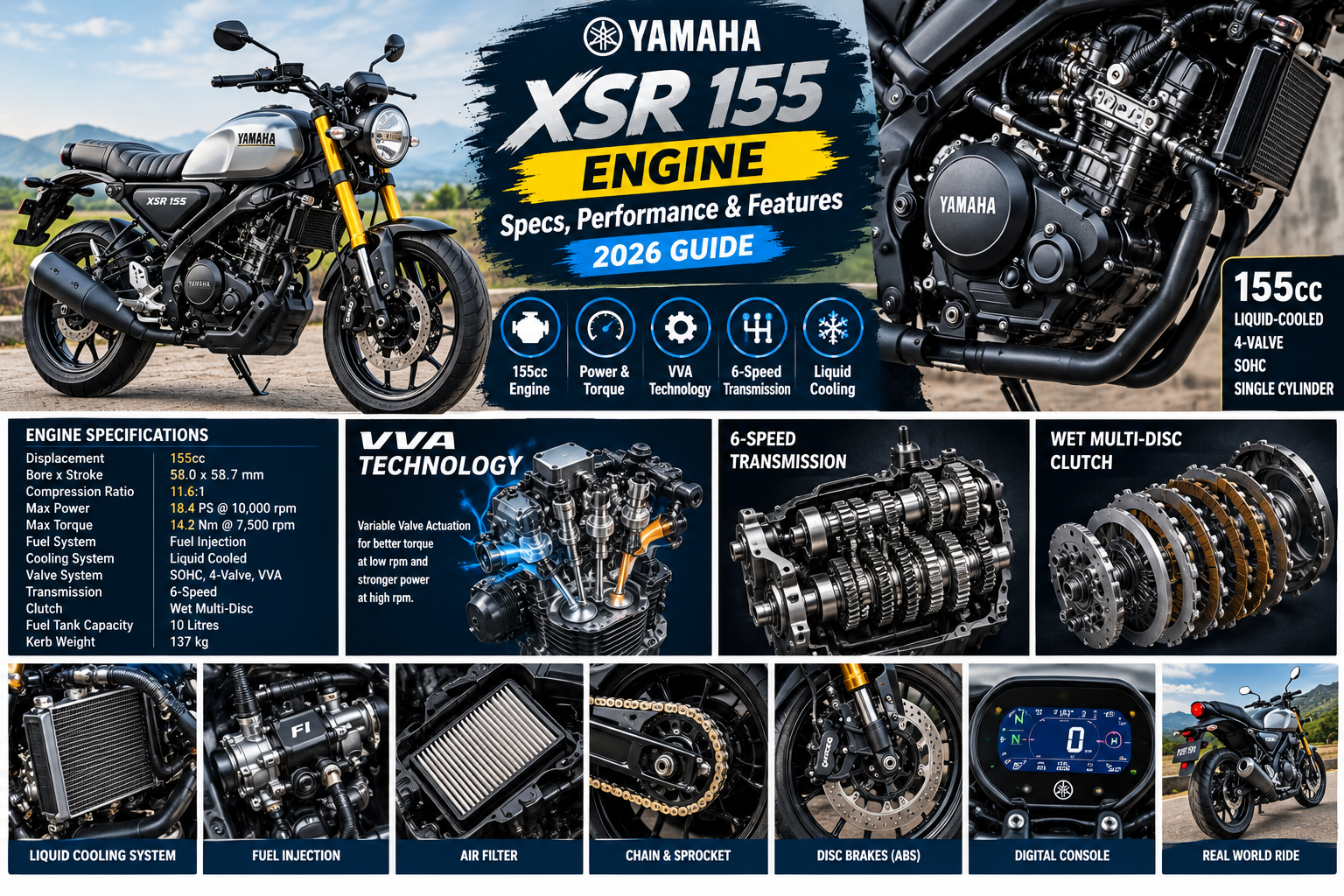
The Yamaha XSR 155 is a motorcycle that combines classic-inspired styling with modern engine technology. Its appearance may remind riders of traditional motorcycles, but underneath that retro design is a modern 155cc liquid-cooled engine designed for responsive performance and everyday usability.
The engine is one of the most important parts of the XSR 155. It uses a four-stroke, SOHC, four-valve, single-cylinder layout with electronic fuel injection and Variable Valve Actuation (VVA).
Yamaha lists a claimed maximum output of 18.4 PS at 10,000 rpm and maximum torque of 14.2 Nm at 7,500 rpm. The engine is paired with a six-speed transmission and wet multi-disc clutch.
This guide explains the XSR 155 engine in simple technical terms, including its specifications, VVA technology, cooling system, fuel injection, transmission, performance characteristics and important maintenance considerations.
Yamaha XSR 155 Engine Specifications
The main engine specifications include:
- Engine type: Liquid-cooled, four-stroke, SOHC, four-valve
- Cylinder configuration: Single cylinder
- Displacement: 155cc
- Bore: 58.0 mm
- Stroke: 58.7 mm
- Compression ratio: 11.6:1
- Maximum power: 18.4 PS at 10,000 rpm
- Maximum torque: 14.2 Nm at 7,500 rpm
- Fuel system: Electronic fuel injection
- Valve technology: VVA
- Starting system: Electric starter
- Transmission: Six-speed
- Clutch: Wet multi-disc
- Fuel tank capacity: 10 litres
- Kerb weight: 137 kg
The current Yamaha India specification also lists the XSR 155 as E20 compatible.
What Type of Engine Does the XSR 155 Use?
The XSR 155 uses a liquid-cooled, four-stroke, single-cylinder engine with a single overhead camshaft and four valves.
This combination is designed to provide a balance between compact engine dimensions, good breathing capability and performance at higher engine speeds.
The four-valve cylinder head is particularly useful when the engine needs to move a larger volume of air at higher rpm.
Instead of using a basic commuter-style engine configuration, Yamaha has equipped the XSR 155 with technology intended to provide a wider performance range.
Understanding the 155cc Displacement
Engine displacement refers to the total volume swept by the piston inside the cylinder.
The XSR 155 has a displacement of 155cc, with a bore of 58.0 mm and a stroke of 58.7 mm.
These dimensions create a relatively compact engine package while allowing the engine to operate effectively across a broad rpm range.
A 155cc engine does not automatically tell us how fast a motorcycle will accelerate or what its top speed will be.
Engine output, gearing, motorcycle weight, aerodynamics, tyres, rider weight and road conditions all influence real-world performance.
Yamaha XSR 155 VVA Technology
One of the most interesting features of the XSR 155 engine is Yamaha’s Variable Valve Actuation, commonly called VVA.
VVA is designed to change valve operation characteristics according to engine speed.
A motorcycle engine needs different valve characteristics at different rpm ranges.
At lower engine speeds, the engine benefits from characteristics that support useful torque and smooth operation.
At higher engine speeds, the engine needs to breathe effectively to continue producing power.
VVA helps address this difference by using different valve-control characteristics across the engine’s operating range.
For the rider, this means the engine can provide useful response at normal speeds while still having a stronger high-rpm character.
Why VVA Matters During Riding
The XSR 155 produces its maximum power at 10,000 rpm.
That means the engine is designed to continue producing useful performance as the rpm rises.
When riding slowly through traffic, the engine does not need to be constantly operated at high rpm.
However, when stronger acceleration is required, selecting the appropriate gear and allowing the engine to rev can make a noticeable difference.
This is one reason why understanding the engine’s power characteristics is more useful than simply looking at the displacement number.
Maximum Power and Torque
The XSR 155 produces a claimed:
18.4 PS at 10,000 rpm
and
14.2 Nm at 7,500 rpm.
The torque figure tells us about the engine’s ability to produce rotational force, while the power figure reflects how effectively that force is delivered as engine speed increases.
For everyday riding, torque helps the motorcycle respond when accelerating from lower and medium speeds.
At higher rpm, the engine’s power output becomes increasingly important.
This gives the XSR 155 a more performance-oriented character than a motorcycle designed purely around low-speed commuting.
Liquid Cooling System
The XSR 155 uses liquid cooling.
In a liquid-cooled engine, coolant circulates through passages around the engine to absorb heat.
The heated coolant then travels to the radiator, where heat is transferred to the surrounding air.
After cooling, the coolant returns to the engine and continues the cycle.
This system helps maintain a controlled engine operating temperature, particularly when the motorcycle is being ridden in traffic, under load or at higher rpm.
Why Engine Temperature Matters
An engine that becomes excessively hot can experience increased wear and reduced performance.
Proper coolant level, radiator condition and correct maintenance are therefore important.
Riders should never open a hot radiator or pressurized cooling-system component.
Always allow the engine to cool before inspecting the cooling system.
Four-Valve Cylinder Head
The XSR 155 uses four valves in its cylinder head.
A four-valve configuration generally allows efficient intake and exhaust gas flow through the cylinder head.
Two intake valves and two exhaust valves provide a useful valve area while allowing the engine to remain compact.
The four-valve head works together with fuel injection, VVA and the liquid-cooling system to support the engine’s performance characteristics.
Electronic Fuel Injection
The XSR 155 uses electronic fuel injection instead of a traditional carburetor.
Fuel injection allows the engine management system to control fuel delivery electronically.
This helps provide consistent fuel delivery under different operating conditions.
It also supports easier starting and predictable throttle response when the engine is properly maintained.
For owners, keeping the air filter, fuel system and electrical connections in good condition is important.
If the motorcycle develops poor starting, unstable idle or unusual throttle response, replacing parts randomly is not the correct approach.
The fuel, ignition, air intake and sensor systems should be diagnosed systematically.
Six-Speed Transmission
The XSR 155 uses a six-speed manual transmission.
Having six gears gives the rider more flexibility in keeping the engine within a useful rpm range.
Lower gears are useful for:
- Starting from a stop
- Slow traffic
- Climbing
- Strong acceleration
Higher gears are useful for:
- Open roads
- Steady cruising
- Maintaining speed with suitable engine rpm
Good gear selection can make the engine feel smoother and more responsive.
Wet Multi-Disc Clutch
The XSR 155 uses a wet multi-disc clutch.
A wet clutch operates with lubrication around the clutch assembly and uses multiple friction plates to transfer engine power to the gearbox.
The clutch plays an important role when starting, changing gears and controlling the motorcycle at low speeds.
Proper clutch adjustment and correct riding technique can help reduce unnecessary clutch wear.
Avoid keeping the clutch partially engaged for long periods, especially in heavy traffic.
XSR 155 Engine Performance in City Riding
The XSR 155’s engine can be used effectively in everyday urban riding when the rider selects appropriate gears.
In slow traffic, smooth throttle control is more important than constantly using high rpm.
The six-speed gearbox gives the rider enough flexibility to select a suitable gear as speed changes.
Because the engine produces peak torque at 7,500 rpm, riders should not expect every gear to provide identical acceleration at every engine speed.
Selecting the right gear is part of using the engine correctly.
Performance on Open Roads
On open roads, the XSR 155 engine’s higher-rpm character becomes more noticeable.
Its maximum power is produced at 10,000 rpm, so the engine has a relatively high operating range for a 155cc motorcycle.
When overtaking, selecting an appropriate lower gear can allow the engine to move into a stronger part of its power range.
However, real-world acceleration depends on many factors.
These include:
- Rider weight
- Passenger load
- Wind
- Road gradient
- Tyre condition
- Motorcycle maintenance
- Fuel quality
- Gear selection
- Riding position
Therefore, a claimed power figure should not be treated as a guarantee of a particular acceleration or top-speed result.
Fuel Efficiency and Riding Style
Fuel economy is not a fixed number.
The same motorcycle can deliver different fuel consumption depending on how it is ridden.
Aggressive acceleration, frequent high-rpm riding, heavy traffic, low tyre pressure and additional load can increase fuel consumption.
A smoother riding style, correct gear selection and proper motorcycle maintenance can help improve efficiency.
The XSR 155’s 10-litre fuel tank provides useful capacity for everyday riding, but actual riding range depends on real-world fuel consumption.
Engine Maintenance Basics
A modern 155cc performance-oriented engine should be maintained according to the manufacturer’s service schedule.
Engine Oil
Use the engine oil grade and specification recommended for the motorcycle.
Do not choose oil only because another motorcycle uses the same viscosity.
Correct oil helps lubricate internal engine components and supports proper operation of the clutch and gearbox.
Air Filter
The engine requires clean air for proper combustion.
A dirty or restricted air filter can affect airflow and engine response.
Inspect and replace the filter according to the recommended maintenance schedule.
Coolant
Because the XSR 155 is liquid cooled, coolant condition is important.
Check the coolant level using the correct procedure.
Never open a hot cooling system.
Drive Chain
The engine’s power reaches the rear wheel through the chain drive.
A chain that is too loose, too tight, dry or heavily worn can reduce smoothness and increase component wear.
Inspect chain condition and maintain lubrication and adjustment according to the manufacturer’s recommendations.
Engine Warm-Up
Modern fuel-injected engines do not need long periods of stationary idling before every ride.
After starting the motorcycle, allow the engine to settle and then ride smoothly while it reaches normal operating temperature.
Avoid immediately demanding maximum engine performance from a completely cold engine.
Gradual operation helps the engine reach normal temperature under controlled conditions.
Common Symptoms That Need Attention
Riders should not ignore changes in engine behavior.
Possible warning signs include:
- Difficult starting
- Repeated stalling
- Unstable idle
- Excessive engine noise
- Poor throttle response
- Unusual smoke
- Engine overheating
- Coolant loss
- Oil leakage
- Unusual vibration
- Check-engine warning
A single symptom does not automatically identify the failed component.
For example, poor starting can involve fuel delivery, ignition, battery condition, sensors or other systems.
Proper diagnosis is better than replacing parts based only on symptoms.
How to Keep the XSR 155 Engine Healthy
A few basic habits can help maintain the engine:
- Follow the recommended service schedule.
- Use the correct engine oil.
- Check fluid levels regularly.
- Keep the air filter clean.
- Maintain the drive chain correctly.
- Monitor coolant level.
- Keep the radiator area clean.
- Avoid unnecessary high-rpm operation when the engine is cold.
- Do not ignore warning lights.
- Repair oil or coolant leaks promptly.
- Maintain correct tyre pressure.
- Use genuine or manufacturer-approved replacement parts where appropriate.
XSR 155 Engine and Motorcycle Weight
The engine’s performance is also influenced by the motorcycle’s overall weight.
Yamaha lists the XSR 155 at 137 kg kerb weight, including oil and a full fuel tank.
A relatively manageable motorcycle weight can help the engine’s available power feel more useful during acceleration and everyday riding.
The actual riding experience still depends on rider weight, road conditions and riding technique.
Engine and Chassis Working Together
A motorcycle engine cannot be judged independently from the rest of the machine.
The XSR 155 uses a Deltabox frame along with an upside-down front fork and link-type rear suspension.
It also uses disc brakes at both ends and dual-channel ABS.
The front tyre is specified as 100/80-17 and the rear as 140/70R-17 radial tubeless.
These components help the motorcycle make practical use of the engine’s performance.
Electronic Features Supporting the Engine
The XSR 155 also includes several modern electronic features.
Depending on the specification, Yamaha lists features such as:
- VVA
- Traction control
- Y-Connect smartphone connectivity
- Digital instrumentation
- Fuel-consumption information
- Digital tachometer
- Digital fuel gauge
- LED lighting
- Dual-channel ABS
Traction control can help reduce excessive rear-wheel spin in certain low-grip situations.
However, electronic rider aids cannot replace good tyres, appropriate speed and careful throttle control.
Is the XSR 155 Engine Suitable for Beginners?
The answer depends on the rider’s experience and riding habits.
The motorcycle has a manageable 155cc displacement, but its performance-oriented engine characteristics mean that beginners should learn smooth throttle control, braking and gear selection before trying to use its full performance.
A new rider should concentrate on:
- Smooth clutch release
- Correct gear selection
- Controlled acceleration
- Proper braking
- Safe cornering
- Understanding road conditions
Learning these skills is more important than trying to reach maximum rpm.Read also diy-car-repair-guide-for-beginners
Final Thoughts
The Yamaha XSR 155 engine is a modern 155cc powerplant that combines liquid cooling, four-valve technology, electronic fuel injection and VVA.
Its claimed 18.4 PS output at 10,000 rpm and 14.2 Nm torque at 7,500 rpm give the engine a performance-oriented character, while the six-speed transmission allows the rider to use that performance across a broad range of speeds.
The real strength of the engine is not one specification alone.
The combination of VVA, fuel injection, liquid cooling, four valves, six-speed gearing and a wet multi-disc clutch creates a package designed for both everyday riding and more enthusiastic use.
For long-term reliability, regular maintenance remains essential. Correct engine oil, clean air filtration, proper coolant level, good chain maintenance and timely servicing can help the engine continue performing properly.
The XSR 155 is therefore interesting not simply because of its retro appearance, but because modern engine technology sits underneath that classic-inspired design.
For riders who enjoy understanding how their motorcycle works, the XSR 155 provides a good example of how a compact engine can combine everyday usability with modern performance technology.
2 thoughts on “Yamaha XSR 155 Engine – Specs, Performance & Features (2026 Guide)”